What Power
Actually Is
The fundamental concept from which everything else is derived
The Grammar of Power
The Definition
What is power? The question sounds simple and is not. Three different answers have been given by the serious literature on the subject, and they are not the same answer, even though they are often treated as if they were.
The first answer is power as capacity. On this account, power is what an actor possesses: military capability, economic resources, technological sophistication, territory, population. A state with a large army and a productive economy is powerful. A state with neither is not. This is the most intuitive definition and the most commonly used in journalistic and policy discourse. When analysts produce indices of national power, they are measuring this kind of power.
The second answer is power as relationship. On this account, power only exists in specific interactions between specific actors. A nuclear arsenal is not power in a vacuum. It is power over particular parties who have reason to fear its use. This view, developed most rigorously by the political scientist Robert Dahl in his work on American pluralism in the 1950s, holds that A has power over B to the extent that A can get B to do something B would not otherwise do. Power is not a thing anyone holds. It is something that exists, or fails to exist, between parties in a specific context.
The third answer is power as outcome. On this account, the real test of power is not capacity possessed or relationship established but intended effect achieved. This is Bertrand Russell's definition, the one that runs through this curriculum. In Power: A New Social Analysis, published in 1938, at the moment when European fascism was demonstrating what the mobilisation of organised power could accomplish, Russell defined power as the production of intended effects. Simple. Brutal. Exact.
Russell wrote in 1938 that power is to the social sciences what energy is to physics: the fundamental quantity from which everything else is derived. This curriculum is built on that conviction.
The distinction between these three definitions matters practically and not just philosophically. A state can have enormous capacity without being able to produce intended effects: the United States military in Vietnam, in Iraq, in Afghanistan. A relationship of formal dominance can coexist with actual impotence: the Soviet Union's relationship with Yugoslavia after Tito's break with Moscow in 1948. And the production of intended effects can occur through mechanisms that bear no obvious relationship to the standard measures of capacity: a small state whose cooperation is essential to a critical chokepoint can extract concessions from states with a hundred times its military budget.
Russell's definition cuts through all of this. It asks not what you possess or how you stand in formal relationship to others, but what you can actually cause to happen in the world. That is the question this curriculum returns to again and again.
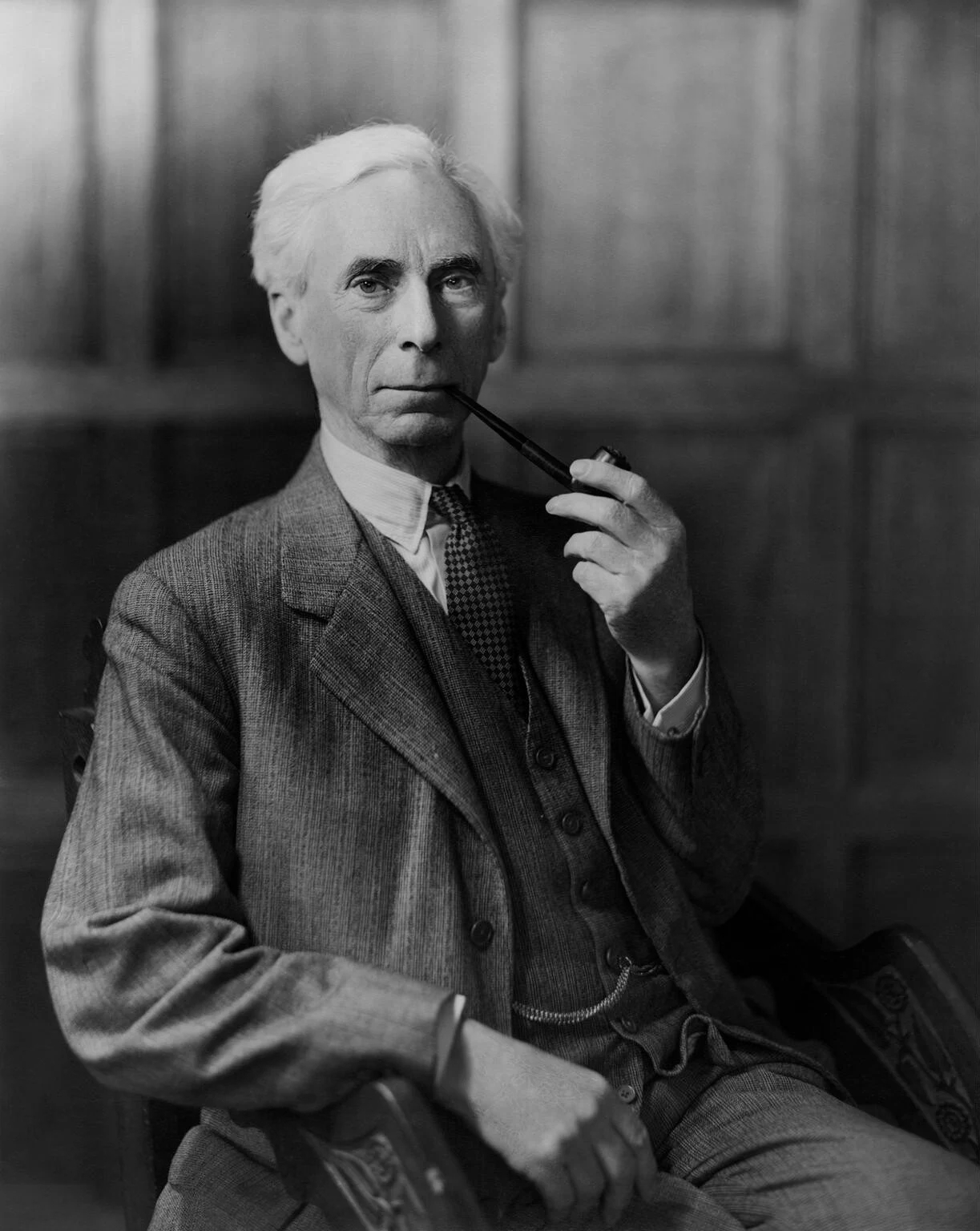
Bertrand Russell, photographed in 1957. His 1938 work defined power as the production of intended effects, the foundational claim of this curriculum.
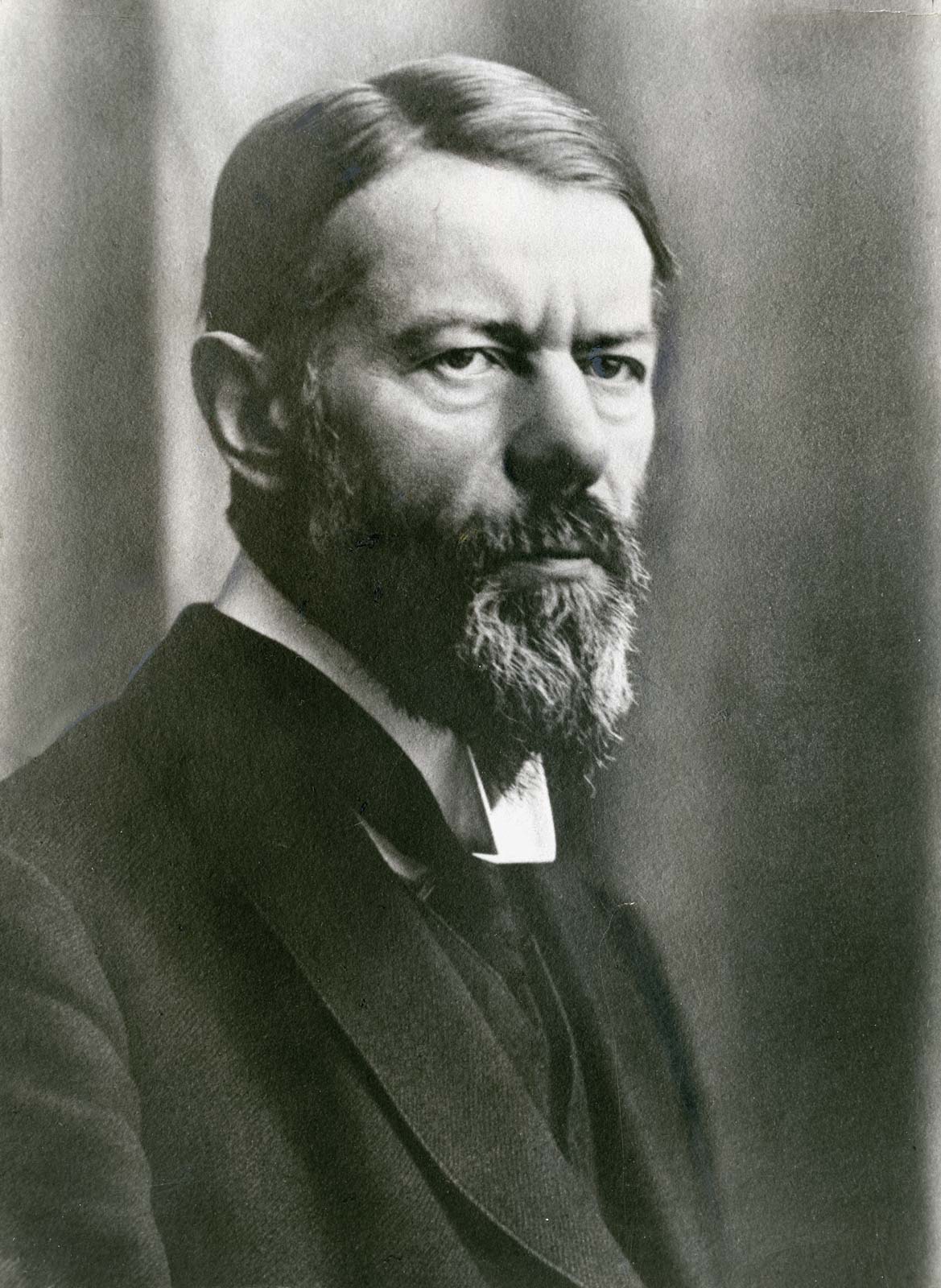
Max Weber, whose taxonomy of traditional, charismatic, and rational-legal authority remains the foundational framework for understanding where power comes from.
Power is not a thing that anyone holds. It is an outcome produced by the interaction of capacity, relationship, and legitimacy.
Where Power Comes From
Capacity does not explain itself. A large army is a fact. The question is why soldiers obey orders. A formal hierarchy is a fact. The question is why people within it comply. The sociology of power begins not with the instruments of compulsion but with the sources of legitimacy, the reasons why those subject to power accept it as valid rather than merely inevitable.
Max Weber, writing in Wirtschaft und Gesellschaft, the great posthumously published work completed around 1920, identified three ideal types of legitimate authority. He called them traditional, charismatic, and rational-legal, and the taxonomy has organised the sociology of power ever since.
Traditional authority rests on the legitimacy of the eternal past, on the sanctity of customs which have always existed. A king rules because kings have always ruled, because his father ruled and his father's father ruled, and the chain of precedent runs back to a foundation that is treated as sacred rather than questioned. The authority is real, but it is entirely backward-looking. Its greatest strength is also its greatest weakness: it provides extraordinary stability in stable conditions and collapses catastrophically when conditions change, because it has no mechanism for generating new legitimacy.
Charismatic authority rests on the perceived exceptional qualities of an individual person, on devotion to the specific and exceptional sanctity, heroism, or exemplary character of an individual. Weber was careful to note that charisma is not the same as popularity or talent. It is a specific kind of claim, a claim to break the normal rules because the individual embodies something beyond the normal rules. Religious prophets, military commanders who inspire armies beyond rational calculation, political leaders who appear in moments of crisis and seem to incarnate a collective yearning: these are the carriers of charismatic authority.
Weber identified what he called the problem of routinisation. Every charismatic movement faces a specific crisis: what happens when the charismatic leader dies? The movement must either institutionalise, convert its energy into stable organisational forms that can outlast the individual, or dissolve. The institutionalised charisma of a successor organisation is never as powerful as the original, because it has been converted from personal magnetism into rules, but it is far more durable.
Rational-legal authority rests on the belief in the legality of enacted rules and the right of those elevated to authority under such rules to issue commands. This is the dominant form of legitimate authority in modern states. The president has authority because the constitution says so. The judge has authority because statute law says so. The police officer has authority because regulation and legislation say so.
Weber was both the great analyst and the great critic of rational-legal authority. His concept of the iron cage described the progressive bureaucratisation of modern societies: rational-legal systems are extraordinarily efficient, and efficiency ensures their expansion, but they replace human judgment with procedure in a way that is ultimately dehumanising. The civil servant who follows the rule even when following the rule produces a manifestly unjust outcome is doing exactly what the system requires of them. That is both rational-legal authority's strength and its pathology.
The three types interpenetrate in practice. Every modern rational-legal system carries residual traditional elements: constitutional structures that are treated as sacred even when they are dysfunctional, ceremonial forms that derive their authority from precedent rather than rational justification. And every modern political system is vulnerable to charismatic disruption. Weber wrote this analysis in the 1910s and early 1920s, watching the rise of mass politics in Europe. The disruption he was describing was about to take historical form in ways that would demonstrate his taxonomy with terrible precision.
The Instruments of Power
Understanding that power exists is not the same as understanding how it operates. The instruments through which power is exercised have been classified in several ways, but the most analytically useful classification for the contemporary world is the distinction between hard power, soft power, and sharp power.
Hard power is compulsion: military force and economic coercion. It is the oldest instrument and the most direct. It does not require the consent of the subject. An army that occupies your territory imposes its will whether or not you find it legitimate. A sanctions regime that cuts off your access to the global financial system does the same. Hard power is expensive, it generates resistance, and it typically requires continuous application to maintain its effect.
Soft power is the concept introduced by Joseph Nye in Bound to Lead, published in 1990, and developed further in The Future of Power in 2011. Nye's specific argument is that soft power is not propaganda or public relations. It is the genuine attractiveness of a society's culture, values, and political institutions. When people around the world want to emigrate to your country, consume your cultural products, speak your language, and adopt your political models, you have soft power. It operates by shaping preferences rather than constraining behaviour.
Nye's argument has a critical implication. Soft power cannot be manufactured directly. It is a byproduct of the genuine quality of what a society is and does. A state that attempts to project soft power through propaganda while its domestic institutions are corrupt and its culture is repressive will fail, because the audience it is trying to attract can see the gap between the projection and the reality. The United States had extraordinary soft power through most of the second half of the twentieth century not primarily because of its public diplomacy budget but because American universities, American culture, American technology, and the American political model were genuinely attractive to large numbers of people.
Sharp power is the most recently theorised concept, introduced in a 2017 report by the National Endowment for Democracy. It describes the manipulation of information environments by authoritarian states to undermine the function of open societies rather than to project attractive images. Sharp power does not try to win over audiences. It tries to confuse them, to discredit the information sources they rely on, to introduce so much noise into the information environment that distinguishing signal from interference becomes practically impossible.
The relationship between these three instruments is more complex than a simple hierarchy. Hard power without soft power is always expensive and unstable. An occupying army that generates no legitimate authority must maintain itself entirely through coercion, and coercion is costly. The most durable power structures are those that convert hard-power advantages into soft-power legitimacy, that translate the capacity to compel into the preference to comply. Soft power without any hard power behind it is ultimately unenforceable: a society that is attractive but cannot defend its attractiveness will eventually find its model imported and its substance exported until it has neither.
Machiavelli separated the analysis of power from the framework of morality that every previous analyst had felt obliged to maintain. The rulers who denounced him most vigorously were often his most diligent students.
Machiavelli and the Structure of Power Without Illusions
No text in the history of political theory has caused more offence or been more systematically misread than The Prince, written by Nicolo Machiavelli in 1513, probably as a job application to the Medici rulers of Florence from whom he had recently been tortured and exiled.
Machiavelli's offence was not that he was cynical. His predecessors in the advice-to-rulers tradition had been quite capable of cynicism. His offence was that he separated the analysis of power from the framework of Christian morality that every previous analyst had felt obliged to maintain, at least formally. He described what actually works rather than what ought to work, and the two turned out to be substantially different.
His most famous claim, that it is better to be feared than loved if a prince cannot be both, is not a preference for cruelty. It is a structural observation. Love is conditional on the prince's continuing to provide what the subject values. If circumstances change, or if the subject's calculation of interest changes, love evaporates. Fear is more reliable because it is rooted in self-preservation, which is a more consistent motive. A prince who depends on the affection of his subjects is dependent on something outside his control. A prince who generates fear has internalised his control mechanism in his subjects.
The fox can recognise traps but cannot defeat wolves. The lion can defeat wolves but cannot recognise traps. The effective ruler must know when to be the lion and when to be the fox. Force alone is insufficient. Intelligence alone is insufficient. This is not a prescription for amorality. It is a description of the conditions under which power actually operates.
Machiavelli's discussion of what he calls cruelty well used versus cruelty badly used contains a principle that has been tested across centuries. Cruelty well used, he argues, is that inflicted once at the start, for the sake of security, and afterwards not persisted in but converted into benefits for the subjects. The structural principle is the same one that organises deterrence theory in nuclear strategy: the credibility of the threat depends on its being believed, and its being believed depends on the decision-maker's demonstrated willingness to act.
Machiavelli was shocking not because he was wrong but because he said openly what everyone who held power already knew.
Consent and the Deepest Form of Power
Bertrand Russell's taxonomy of power forms identifies three distinct mechanisms. Physical power over bodies is the most visible and the least stable. Power over minds through what he calls propaganda is more pervasive and more durable. Power over opinions through control of what information is available is the most powerful of all, because those who hold it can shape the range of conclusions that others are capable of reaching without their ever being aware that their range has been shaped.
This taxonomy anticipates the insight that Hannah Arendt developed with more philosophical rigour in On Violence, published in 1970. Arendt's argument begins with a distinction that is easy to state but difficult to hold in mind: power and violence are not merely different instruments. They are opposites. Power, for Arendt, is the human ability to act in concert. It belongs to a group and exists only as long as the group acts together. Violence, by contrast, is a tool that individuals and small groups can use to impose their will.
The specific implication is counterintuitive and important. A government that maintains itself through violence has already lost power in the genuine sense. It has demonstrated that it can no longer act in concert with its population. The violence is the symptom of power's absence, not its exercise. Arendt used the late stages of the Roman Empire and the late Soviet Union as her primary examples: systems that maintained their formal structures long after the substance of legitimate authority had evaporated, through increasing reliance on coercion that itself revealed the loss of genuine power.
The most durable forms of power are those which the subjects no longer experience as power at all. When the beliefs, preferences, and desires of the subject have been shaped such that they would choose to comply even in the absence of any external compulsion, the power holder has achieved something that no army can guarantee. Antonio Gramsci, writing in prison in fascist Italy in the 1930s, called this cultural hegemony: the process by which the dominant group in a society makes its particular vision of the world appear to be common sense, natural, inevitable.
The question it poses for any reader in any society is not whether visible coercive power is being exercised. It is whether the preferences and beliefs they experience as their own have been shaped by the structure of power in ways they are not aware of.
The most durable forms of power are those which the subjects no longer experience as power at all.
The Neuroscience of Power
Lord Acton's dictum, that power tends to corrupt and absolute power corrupts absolutely, is one of the most frequently quoted observations in political discourse and one of the least examined. It is generally taken as a moral claim: that the experience of holding power has a corrupting effect on the character of the power holder. The interesting question is whether it is actually true and, if so, why.
The social psychologist Dacher Keltner has spent two decades studying the effects of power on behaviour and cognition, and his findings are both precise and disturbing. In study after study, Keltner and his colleagues have demonstrated that the experience of holding power, even temporarily and in experimental conditions, reliably produces specific cognitive and behavioural changes. Power holders are more likely to interrupt others in conversation, less likely to take the perspective of others, more likely to act on impulse, less likely to attend to social norms.
The naturalistic studies are particularly striking. Keltner's team conducted observations of traffic behaviour in several cities and found that the drivers of more expensive vehicles were significantly more likely to cut off other drivers at intersections and to fail to yield to pedestrians at crosswalks. The relationship held even controlling for other variables. The car was a proxy for socioeconomic status, and the socioeconomic status was predicting a specific pattern of social behaviour: treating the rules that apply to others as less applicable to oneself.
The cookie study is perhaps the most vivid illustration of the mechanism. In this experimental design, groups of three participants are randomly assigned to roles, with one designated as the evaluator of the other two. The group is given a plate of five cookies. In virtually every repetition of the experiment, the randomly assigned evaluator takes the fourth cookie when the group is clearly not going to eat the fifth. They take it without asking, and they eat it with their mouths open. The behaviour is not correlated with any pre-existing character trait of the individual. It is a product of the structural position.
The corrupting effects of power are not primarily a character problem. They are an environmental problem. The solution is not to find and install virtuous people. It is to design systems that structurally constrain the pathological behaviours that any person in a position of power will tend to exhibit.
This is precisely the insight that animates the design of constitutional checks and balances, judicial independence, term limits, and free press institutions. Not because the founders of these systems had read Keltner but because centuries of observing what power does to people had produced the same conclusion by empirical means.
The Mechanics of Power Transition
Theory must be tested against cases. The two most instructive modern cases of large-scale power transition, one peaceful and one not, reveal how the grammar of power actually operates at civilisational scale.
The transfer of hegemonic power from the United Kingdom to the United States in the early twentieth century is, in retrospect, the most remarkable peaceful power transition in recorded history. At the end of the nineteenth century, the British Empire controlled roughly a quarter of the earth's land surface and exercised hegemonic financial and commercial influence over large parts of the remainder. By 1945, that hegemony had been transferred to the United States, and the transfer, while not without friction, did not produce a direct Anglo-American war.
The mechanisms are instructive. The First World War financially exhausted Britain while relatively strengthening the American position. By 1918, Britain had become a net debtor to the United States for the first time in its modern history. At the Bretton Woods conference in 1944, American representatives, with John Maynard Keynes arguing unsuccessfully for a different architecture, established the dollar as the world's reserve currency and the American-dominated International Monetary Fund and World Bank as the institutional architecture of the new order. The transition was accomplished through financial architecture rather than military contest.

The Mount Washington Hotel at Bretton Woods, where the 1944 conference designed the institutional architecture of post-war American hegemony. John Maynard Keynes and Harry Dexter White argued inside these walls over what the monetary order would become.
The collapse of the Soviet Union in 1991 is the complementary case: a superpower that lost its position without being militarily defeated. The mechanisms here reveal how the deepest form of power, Russell's power over minds and opinions, can dissolve entirely while the physical instruments remain.
The Soviet collapse was not primarily a military failure. The Soviet military remained formidable throughout. It was a legitimacy failure of extraordinary rapidity. The system that had sustained seven decades of Soviet power, the Communist Party's monopoly on information and political organisation, began to disintegrate when Gorbachev's glasnost policy created a space for critical discourse that the system could not tolerate and could not close. Once the subjects of Soviet power could see the gap between what they had been told was true and what they could now observe, the legitimacy of the system evaporated. Arendt's thesis was demonstrated with extraordinary clarity: the violence that maintained the Soviet system through its final years was not evidence of power. It was evidence of its absence.
The Soviet military was still formidable. The Soviet state still existed. The power was gone.
The Grammar Begins
Every artifact in this curriculum adds a rule to the grammar. The first rule, derived from everything in this artifact, can be stated as follows.
Power is not a thing that anyone holds. It is an outcome produced by the interaction of capacity, relationship, and legitimacy. These three components can reinforce each other, in which case the power structure appears stable and inevitable. They can work against each other, in which case the power structure is weaker than it appears. And they can collapse asynchronously: capacity can remain while legitimacy evaporates, as in the late Soviet case; legitimacy can remain while capacity declines, as in the late British imperial case.
The second rule: legitimacy is the most powerful component and the hardest to maintain. Physical compulsion generates resistance immediately. Economic coercion generates resistance and workarounds. But power that has been fully legitimised operates without resistance because it operates without detection. The most powerful states in history have been those that succeeded in making their particular arrangements appear natural, inevitable, and just to the maximum number of people.
The third rule: the structures designed to prevent the pathological effects of power are not luxuries or moral preferences. They are functional requirements for any power structure that intends to persist over time. Unconstrained power degrades the cognitive capacity of those who hold it in ways that make strategic error increasingly likely. The power structure that removes the constraints on its own behaviour has not gained strength. It has scheduled its own failure.
These rules will be tested, extended, and complicated across the eight artifacts that follow. The grammar of power has more rules than three. But these three are the foundation on which everything else is built.
Hard, Soft, and Sharp Power Across Major States
The following comparison visualises the relative deployment of hard power, soft power, and sharp power instruments across the five major actors in the current world order. This is a qualitative assessment rendered visually, not false quantitative precision. The distribution reveals the strategic logic of each actor.
States with limited soft power resources have incentive to develop sharp power, which attacks the preconditions for soft power rather than competing with it directly. The United States faces a strategic challenge that is partly self-inflicted: its hard power has been exercised in ways that damaged the soft power that made that hard power sustainable.