Empires as
Technology
What empires are, how they work, why they collapse in the same pattern across every civilisation that built them, and what they leave behind
The Grammar of Power
Defining the Thing
An empire is not simply a large state. It is not simply a state with colonies. It is a specific kind of political organisation with a specific structural profile: a core population or ruling group that extends political authority over a periphery of populations that are culturally, ethnically, or linguistically distinct from the core, typically through conquest, and maintains that authority through a combination of military force, administrative infrastructure, economic extraction, and ideological legitimation.
The political scientist Alexander Motyl offers a precise structural definition: an empire is a hierarchically organised political system with a hub-and-spoke structure, in which the hub maintains differentiated relationships with a periphery of distinct units that relate to each other primarily through their relationship with the hub rather than through direct horizontal relationships with each other. This captures something important that purely territorial or ideological definitions miss: the imperial relationship is fundamentally about the structure of connections between core and periphery.
Michael Doyle, in his influential 1986 work Empires, defines empire as effective control, whether formal or informal, of a subordinated society by an imperial society. The inclusion of informal empire is important. The British relationship with Argentina in the nineteenth century, in which British capital, British credit, and British naval power shaped Argentine economic and political life without any formal colonial administration, was functionally imperial even though Argentina was formally independent. The United States' relationship with much of Latin America throughout the twentieth century has the structural characteristics of informal empire: the hub-and-spoke pattern of dependency, the differentiated relationships with the core, the economic extraction, and the political influence exercised through economic leverage and military threat rather than direct administrative control.
Empire as Coordination Technology
The most analytically productive way to approach empire is as a technology for solving a specific class of coordination and extraction problems at scales that smaller political units cannot manage. This framing does not romanticise empire or excuse its costs. It asks what specific problems empires solve and why those problems keep being solved by structures with recognisably similar characteristics across civilisations that never encountered each other.
The problems that empires solve are primarily two: the provision of order across large territories and the extraction of surplus from productive populations across those territories. These are not separable. The order is a precondition for the extraction. The extraction is what funds the apparatus that provides the order. The circular relationship between order and extraction is the core of what any empire is and what it does.
The provision of order at imperial scale requires solutions to two specific problems. The first is the security problem: how do you prevent the violence that constant small-scale competition between local polities would otherwise generate? The answer in every empire is the monopolisation of legitimate violence by the central authority. The Pax Romana, the Pax Mongolica, the Pax Britannica are real achievements, however achieved. The trade that flows along safe roads, the agricultural production not destroyed by constant raiding, the specialisation possible only when production does not have to be immediately defensible: these are genuine gains that the imperial structure enables.
The second is the information problem: how do you govern a vast territory from a centre when information travels no faster than a horse? Every large empire faced this problem, and every large empire developed the same set of institutional responses. Governance at imperial scale cannot work through the transmission of decisions from the centre to the periphery in real time. It must work through the transmission of rules and the development of local agents who can apply those rules without constant reference to the centre.
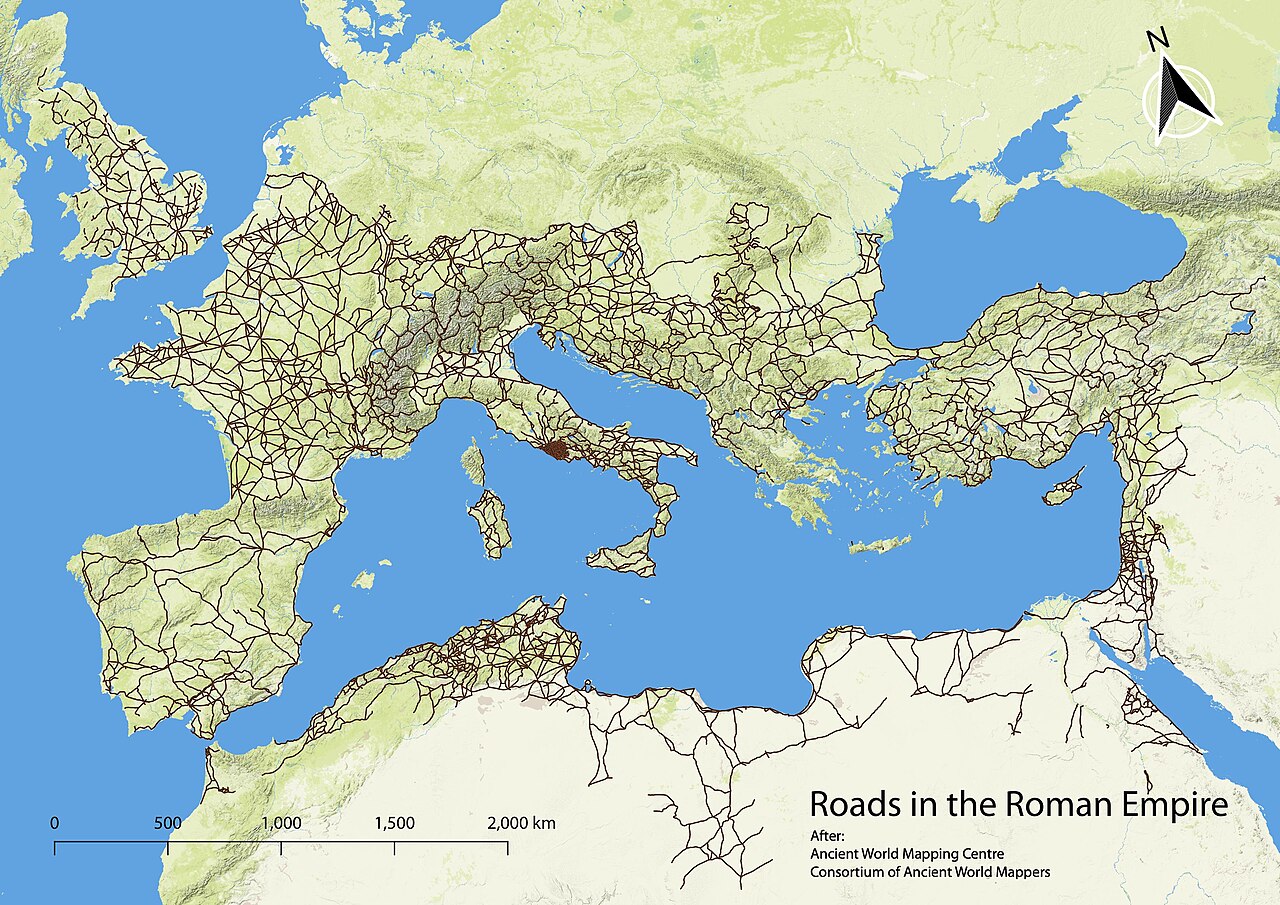
Roads that can carry armies can also carry goods. The Roman road network generated the Pax Romana's trading system as a byproduct of its military function. The distinction between military and economic infrastructure is mostly retrospective.
The Infrastructure of Empire
Every empire that has lasted more than a generation has built the same four categories of infrastructure, not because they copied each other but because these are the structural requirements for maintaining political authority and economic extraction across large territories. The four categories are physical infrastructure, legal infrastructure, monetary infrastructure, and cultural infrastructure.
The most visible and most immediately functional. The Roman road network, ultimately extending to roughly 80,000 kilometres of paved road, is the canonical example. The Persian Royal Road from Sardis to Susa, the Inca road network of 40,000 kilometres across the Andes, the Han dynasty postal relay system: each is a solution to the same structural requirement. Roads that carry armies also carry goods, generating economic integration as a byproduct of military function.
The solution to the transaction cost problem: how do strangers with no prior relationship cooperate commercially at scale? Every empire developed standardised legal systems that defined property rights, enforced contracts, and resolved disputes through procedure rather than violence. Roman law, the Code of Hammurabi, the Qin legal code, the Ottoman Kanun: each is a solution to the same structural problem. The survival of Roman law in the legal systems of almost every European state is evidence of what happens when legal infrastructure outlasts the political structure that created it.
An empire that cannot standardise its medium of exchange cannot efficiently extract surplus, cannot pay its army, cannot integrate its economy. The Roman denarius, the Chinese copper cash, the Byzantine solidus, the Habsburg silver real de ocho, the British pound sterling, the American dollar: each is imperial money. The history of imperial money is also the history of imperial fiscal crisis: every empire that debased its currency to fund military and administrative expenses accelerated its own fiscal dissolution.
The solution to the legitimation problem: how do you make diverse populations accept the authority of a distant centre that does not share their cultural identity? The most remarkable achievement of the Roman Empire was not its roads or its law but its ability to make Roman an identity that provincials from Spain, Syria, Egypt, and Britain would claim as their own. Caracalla's extension of Roman citizenship to virtually all free inhabitants in 212 AD was the formal recognition of a social reality centuries in the making.
The Extraction Mechanism and Its Limits
The functional description of empire as a coordination technology should not obscure what empire actually was in the daily experience of most of the people who lived within it: an extraction mechanism. The surplus that funded the roads, the legions, the administrators, and the court came from somewhere, and that somewhere was the productive labour of the agricultural and artisanal populations of the provinces.
The fundamental problem of imperial taxation is the one that Ibn Khaldun identified: the relationship between extraction rates and revenues is non-linear. Below a certain threshold, taxation is compatible with the continued productivity of the taxed population. Above that threshold, taxation destroys the productive base it is designed to extract from. The empire that exceeds the threshold is in the position of a farmer eating his seed corn: the short-term caloric gain comes at the cost of next year's harvest.
The specific form of the extraction mechanism matters as well as its overall level. Taxation collected through a reliable administrative apparatus with standardised procedures is economically less damaging than taxation collected through tax-farmers, private contractors who purchase the right to collect taxes from a given territory and keep whatever they collect above the contracted amount. Tax farming is a fiscal technology that every empire facing administrative capacity constraints has employed, and it consistently produces the same pathologies: over-extraction of productive populations, enrichment of intermediaries whose interests are opposed to both the imperial centre and the provincial populations, and the progressive corruption of the administrative apparatus. The Roman publicani, the Ottoman iltizam system, the Mughal jagirdari system, and the British East India Company's revenue collection in Bengal are all instances of the same structural problem producing the same structural pathology.
The Frontier Problem and Imperial Overstretch
Every empire that expands must eventually confront the frontier problem: the cost of defending the frontier grows as the frontier extends, while the marginal benefit of additional territory diminishes as the empire incorporates the most productive territories first and the most marginal territories last. At some point, the defensive cost of the frontier exceeds the economic value of the territory it protects, and the empire has reached what Paul Kennedy, in his influential 1987 work The Rise and Fall of the Great Powers, called imperial overstretch.
Kennedy's argument, developed through a comparative study of the great powers from the late fifteenth century to the late twentieth, is that the primary cause of great power decline is the divergence between the military commitments that an empire or hegemon undertakes and the economic base available to fund those commitments. Powers that become great through military superiority tend to sustain and extend their military commitments even as their relative economic position declines, because the military commitments create political constituencies, institutional interests, and strategic obligations that are difficult to reverse.
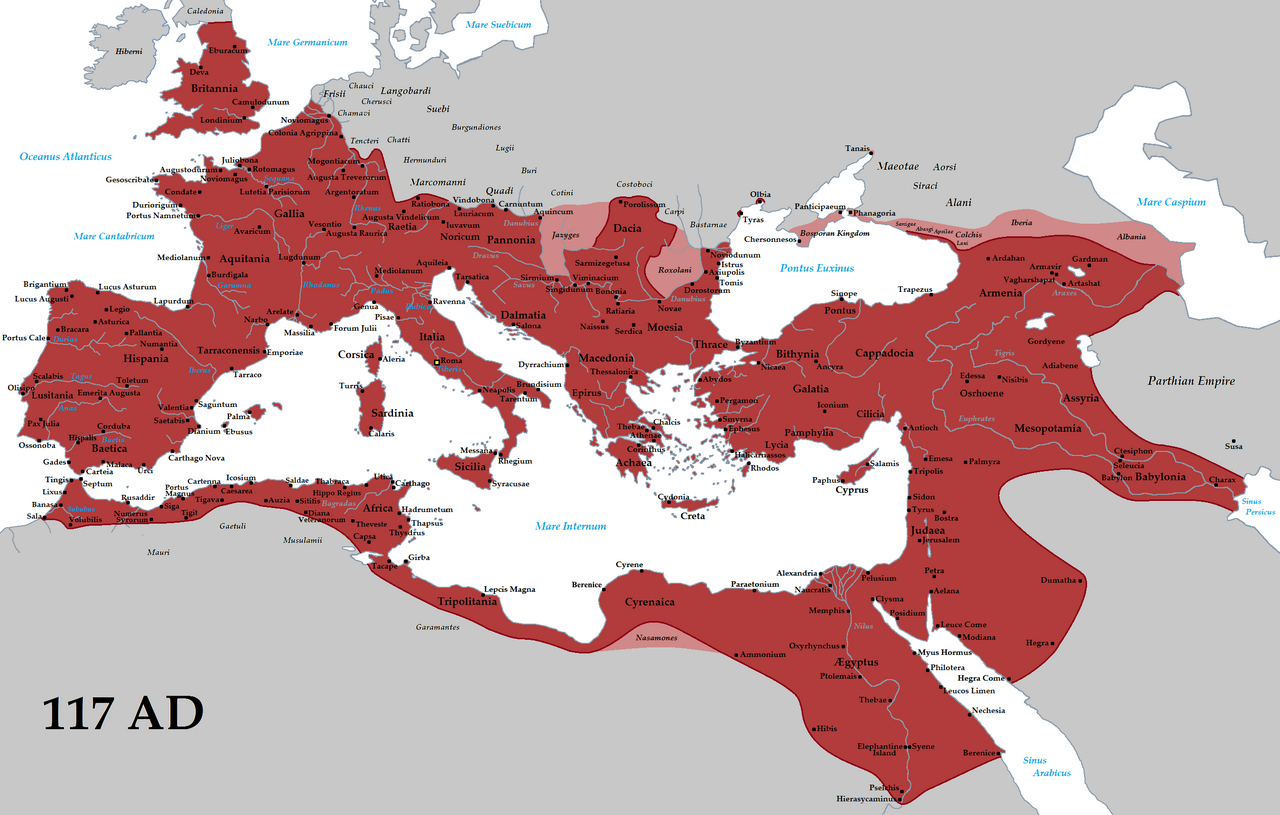
The Roman frontier at its maximum extent under Trajan in approximately 117 AD extended to roughly 15,000 kilometres, from Hadrian's Wall in northern Britain to the Euphrates in Mesopotamia. Defending that frontier required something in the range of 300,000 to 400,000 soldiers at peak periods. The subsequent history of the empire is, in fiscal terms, the story of the progressive divergence between the cost of maintaining that frontier and the revenues available to fund it. The British Empire at its maximum extent in the 1920s controlled roughly a quarter of the world's land surface. The two World Wars consumed the capital and human resources that British global supremacy required, and the post-war period saw the progressive retreat from imperial commitments that the fiscal reality had made inevitable.
The American military's global presence, the network of approximately 800 foreign military bases across over 70 countries, represents a commitment of resources that constitutes imperial overstretch by any structural measure. The structural dynamic does not care about the ideology in which it is dressed.
Every empire carries within it, from the moment of its establishment, the structural dynamics that will eventually produce its dissolution. This is not a pessimistic claim. It is a structural one.
The Seed of Dissolution
Every empire carries within it, from the moment of its establishment, the structural dynamics that will eventually produce its dissolution. The same mechanisms that make empires effective also create the conditions for their eventual failure.
The extraction mechanism creates the resistance that eventually overwhelms the capacity to extract. Beyond the pure fiscal dynamic, extraction creates political consciousness. Populations that experience themselves as being extracted from develop identities defined in part by their resistance to the extraction. The provincial identity that the empire's cultural infrastructure was designed to replace reasserts itself as anti-colonial nationalism.
The administrative apparatus that makes governance at scale possible creates the institutional interests that resist the adaptation the empire needs. The military that demands more funding to defend the frontier is simultaneously the military that makes it impossible to reduce the frontier commitments driving the fiscal crisis. The bureaucracy that administers the provinces is simultaneously the bureaucracy that captures the administrative surplus for itself rather than transmitting it to the centre.
The cultural infrastructure that creates the common identity of empire simultaneously creates the cultural framework within which the empire's subjects can formulate demands for rights and recognition that the imperial structure is not designed to satisfy. The subjects who learn to read the language of imperial law are also subjects who can use that language to challenge the terms of their incorporation. The Protestant Reformation is, among other things, the story of how the Catholic Church's cultural infrastructure for the integration of Western Europe produced the tools through which that integration was challenged.
The Comparative Anatomy of Imperial Collapse
The pattern of imperial collapse is consistent enough across the historical record that it constitutes a recognisable sequence, varying in specific form but stable in underlying structure.
Four Cases in Detail
At its maximum extent under Trajan, governed roughly 50 to 70 million people and maintained the Pax Romana for approximately two centuries. The dissolution sequence followed the anatomy above with textbook fidelity: fiscal stress from military costs, currency debasement from 85 percent to under 5 percent silver content over two centuries, progressive reliance on barbarian foederati, the ideological transformation of Christianity replacing Roman religious culture. Left behind Roman law, the Latin language, and the administrative structures of the Church as institutional seeds for the medieval world.
The largest contiguous land empire in recorded history at roughly 24 million square kilometres. Built with extraordinary speed through military superiority rather than gradual administrative development. The Pax Mongolica enabled the first direct overland connection between China and Western Europe, generating the commercial exchanges that also transmitted the plague that produced the Black Death. Dissolved relatively rapidly into four competing successor khanates because it lacked the cultural and legal infrastructure the Roman model had developed: without those institutional foundations, the structure depended on personal loyalty to the ruling house, and personal loyalty does not survive generational transmission.
One of the most sophisticated administrative structures in the early modern world. The devshirme system, recruiting talented young men from Christian populations, educating and converting them, and training them as soldiers and administrators loyal to the sultan rather than to any regional constituency, was a remarkable institutional solution to the problem of maintaining central control against centrifugal forces. Dissolution played out over three centuries, driven by the divergence between military expenditure on three active frontiers and a stagnant revenue base, progressively managed through devolution to regional strongmen until nationalist challenges in the nineteenth century made the framework unrecoverable.
At the height of the Indian Empire, fewer than 1,000 British officers of the Indian Civil Service governed a population of roughly 300 million people, an administrative ratio only possible through extensive co-optation of Indian intermediaries and institutional structures that could operate at scale with minimal central supervision. Dissolution driven by the two World Wars consuming the capital and human resources that sustained British supremacy, and by the ideology of self-determination that the British government had itself deployed against the Ottoman and Habsburg empires, which could not then be confined to only the defeated parties.
The structural similarity of the dissolution sequences across six empires spanning two thousand years and every inhabited continent is not coincidental. Fiscal stress precedes elite fragmentation precedes military devolution precedes ideological delegitimisation in every case. The specific form differs. The underlying structure does not.
Informal Empire and Its Mechanisms
The analysis of empire cannot be confined to its formal, directly administered variety. Much of the most consequential imperial power in the modern period has operated through informal mechanisms that achieve the functional goals of empire without the administrative costs and political liabilities of formal colonial rule.
The concept of informal empire was developed most systematically by the historians John Gallagher and Ronald Robinson in their influential 1953 article The Imperialism of Free Trade, which argued that British imperial power in the nineteenth century operated as effectively through informal mechanisms of economic and political influence as through the formal administration of colonies. The British relationship with the Ottoman Empire, with China after the Opium Wars, with Argentina, with Brazil, and with numerous other formally independent states was functionally imperial even where it was not formally colonial: British capital financed their infrastructure, British manufactured goods dominated their markets, British banks managed their credit, and the British Navy stood behind the commercial relationships that made this possible.
The significant structural difference between formal and informal empire is not the absence of extraction but the distribution of the costs of governance. In formal empire, the imperial centre bears the administrative cost of governance directly. In informal empire, the local governments bear the administrative costs, funded by the surplus that their populations generate, while the imperial centre extracts the economic benefits through market mechanisms rather than through taxation. This makes informal empire cheaper to operate for the centre, and correspondingly less visible as an imperial relationship to the populations being governed, because the extraction mechanism is presented as the neutral operation of market forces rather than as the deliberate policy of an imperial power.
The defining architectural feature of imperial organisation: peripheral units relate to each other primarily through their relationship with the hub rather than through direct horizontal connections. Infrastructure flows outward from hub to spokes. Surplus flows inward from spokes to hub. The hub controls the terms of all relationships. This structure applies equally to formal colonial empires and to informal economic hegemony.
The most important question is not how empires work while they are working. It is what they leave behind when they stop.
What Empires Leave Behind
Empires leave behind institutional residues that outlast the political structures that created them. Roman law survived the Western Roman Empire by well over a thousand years and shaped the legal systems of every European state and, through those states, the international legal order that governs global commerce today. The English language, spread by the British Empire, is the primary language of international science, commerce, and diplomacy, a structural advantage that accrues to native speakers regardless of any intentional policy.
But empires also leave behind structural disadvantages that outlast them with equal persistence. The borders drawn by colonial powers for administrative convenience, without reference to existing ethnic, linguistic, or political communities, became the international borders of the independent states that emerged from decolonisation, generating the boundary conflicts, ethnic tensions, and state fragility that have characterised the post-colonial world. The economic specialisation imposed by colonial policy, which organised peripheral economies around the export of primary commodities for the benefit of the imperial centre rather than around the diversified industrial development that would have made them more resilient, persisted long after the formal colonial relationship ended, embedded in infrastructure, institutions, and trading relationships that are difficult to reverse.
The specific institutional inheritances that empires leave are not neutral. They are shaped by the interests of the imperial powers that created them, and those interests were not primarily the interests of the populations being governed. Understanding the present distribution of institutional capacity and institutional deficiency across the world requires understanding the specific imperial inheritances that produced it, because the institutional framework within which any country is operating today is, in significant part, a product of the imperial history that shaped that framework.
The American Moment and Its Structural Position
No analysis of empires as technology can avoid the question of whether the current global order constitutes an American empire, informal or otherwise, and if so, what the structural analysis of empires reveals about its probable trajectory.
The American global position has the structural characteristics of informal empire with some formal elements. The dollar's reserve currency status is the monetary infrastructure. The network of bilateral and multilateral trade agreements is the legal infrastructure. The 800-plus military bases in over 70 countries constitute the physical infrastructure. The global dominance of American cultural products, educational institutions, technology platforms, and media represents the cultural infrastructure. The hub-and-spoke structure, in which most states relate to each other partly through their relationship with the United States and the institutions it dominates, is the defining architectural feature of the imperial model.
The structural preconditions for Kennedy's imperial overstretch are present and measurable. The military commitments undertaken since 2001 have consumed resources that, on any honest accounting, exceed the strategic returns they have generated. The fiscal position of the American state, with a national debt approaching $35 trillion and structural deficits that neither major political party has demonstrated the institutional capacity to address, resembles the fiscal position of mature empires in the disintegrative phase of Turchin's secular cycle. The elite fragmentation that Ibn Khaldun's framework predicts for a fourth-generation ruling group is visible in the polarisation of American political life and the breakdown of the institutional norms that constituted the practical foundation of the democratic system.
The Ottoman Empire survived in recognisable form for three centuries after its fiscal position began to deteriorate. Structural analysis identifies the trajectory. It does not set the timetable. Reading the present distribution of global power without accounting for where that distribution is in the long-run structural cycle is the navigational error that the grammar of power is designed to prevent.
The Grammar Extends
Every large-scale political structure is simultaneously a coordination mechanism and an extraction mechanism, and these two functions are in permanent tension. The extraction that exceeds the coordination value it funds destroys the economic base it is designed to tap. The empire that cannot maintain this balance is not being badly governed. It is being consumed by the structural dynamic that all empires eventually face.
The four categories of imperial infrastructure, physical, legal, monetary, and cultural, are structural requirements for maintaining political authority over diverse populations at scale, not optional features. The absence or deterioration of any one weakens the others and eventually produces the cascade of mutually reinforcing failures that constitutes imperial dissolution. Fiscal crisis begins in the monetary infrastructure and cascades outward. Ideological delegitimisation begins in the cultural infrastructure and cascades inward.
The frontier is always the fiscal problem in disguise. The cost of defending whatever territorial or hegemonic position a great power has established tends to grow faster than the revenue available to fund it, and the political economy of military commitments makes those commitments difficult to reverse once they have been made. The actor who cannot periodically reassess and contract the frontier commitment to match the available fiscal base is structurally committed to a trajectory of overstretch, regardless of the ideology that frames the commitment.