The World
Order Now
Every framework established across nine artifacts applied to the present moment. Not prediction. The structural forces operating beneath the surface of current events, made visible by the grammar.
The Grammar of Power · The Final Artifact
The Structural Condition
The first analytical task for anyone attempting to read the present world order is to establish the structural condition from which the current dynamics emerge. Not the immediate causes of specific events, not the biographical details of the leaders involved, not the ideological frameworks through which the participants understand their own actions, but the underlying structural reality that shapes the range of what is possible.
The United States remains the most powerful single state in the international system by most measures. It is no longer dominant by the margin that produced the unipolar moment of 1991 to 2008. The relative gap between American capabilities and those of other significant actors, particularly China, has narrowed substantially and continues to narrow.
The structural preconditions for great-power conflict, a ruling power's growing fear and a rising power's growing confidence, are present and measurable across every relevant dimension. The question is not whether the structural dynamics are operating. They are. The question is whether the mitigating factors are sufficient to manage the structural pressure toward conflict.
Turchin's model applied to the United States, the United Kingdom, France, and several other advanced democracies shows structural preconditions for political instability at or near historical peaks. The wave of democratic backsliding is partly an expression of structural forces that are transnational rather than country-specific.
The convergence of commercial platform incentives, adversary information operations, and the collapse of institutional media authority has produced measurable declines in social trust and deterioration in the shared factual basis for political deliberation. This degradation is an active dynamic likely to worsen as AI-generated content and synthetic media become more capable and accessible.
The combination of the weaponisation demonstrated by the 2022 freezing, the long-run relative decline of American economic dominance, the development of alternative financial architectures by both adversary and non-adversary states, and the fiscal position of the American state are producing a slow but measurable erosion of the structural advantages that dollar hegemony has provided. The erosion will produce a more complex and less efficient international monetary system that provides less leverage for American financial statecraft.
The US-China Competition Through the Grammar
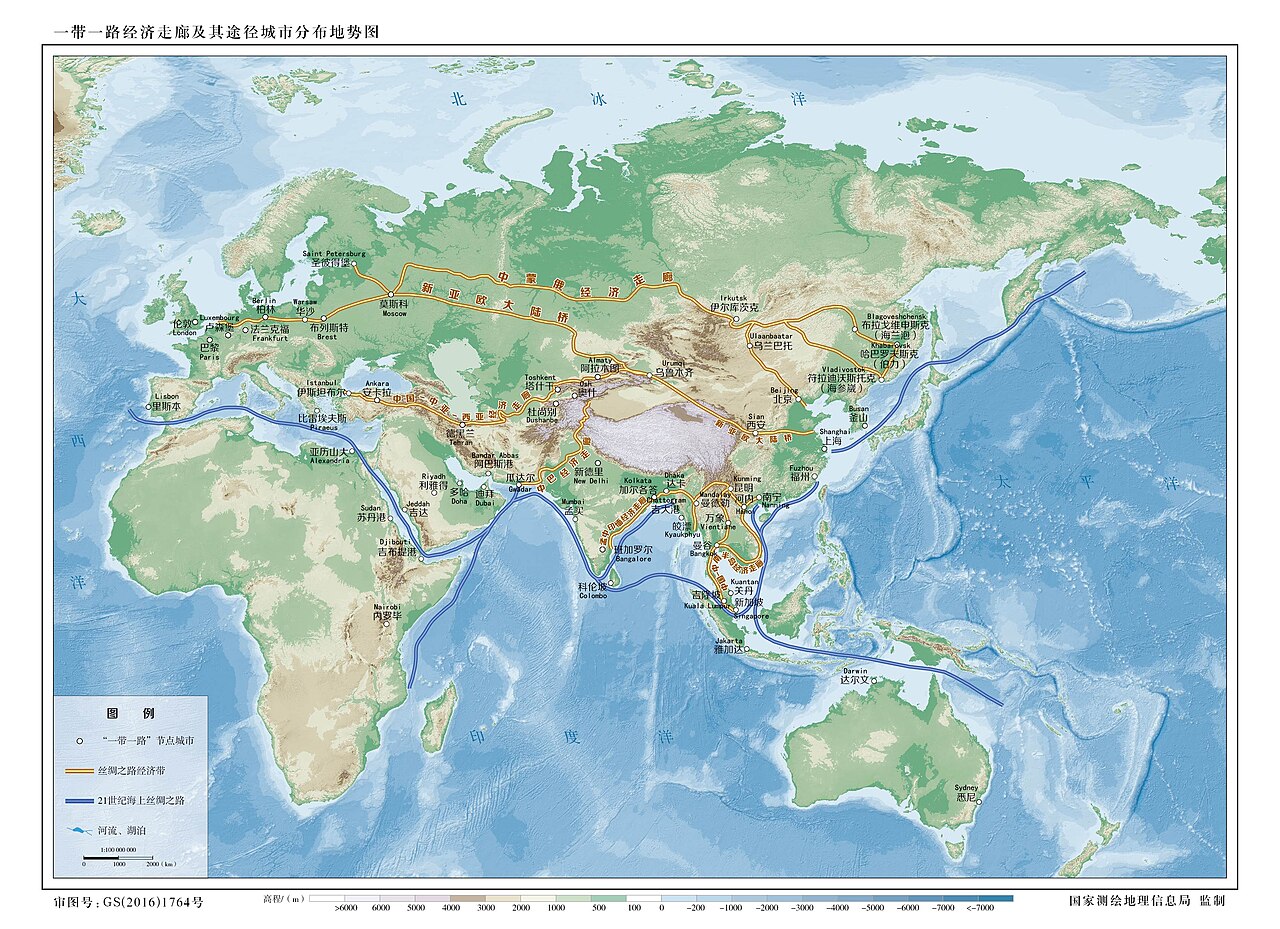
Through the lens of power: American capacity to produce intended effects has declined relative to China's. The American military intervention in Afghanistan ended with the Taliban in control of Kabul. The American attempt to prevent China's rise through economic decoupling has produced friction but has not halted Chinese economic and technological development. Chinese capacity has increased: the Belt and Road Initiative has created infrastructure leverage across significant portions of the developing world, and Chinese military capabilities have developed specifically to contest American dominance in the western Pacific.
Through the lens of strategy: China's approach reflects the Sun Tzu tradition: the patient accumulation of structural advantages, the avoidance of direct confrontation until conditions are maximally favourable. American strategy continues to reflect the Clausewitz tradition: the preference for direct confrontation, the tendency to seek decisive outcomes. The strategic mismatch between these traditions creates specific dangers: an American disposition toward direct confrontation and an adversary deliberately avoiding it creates conditions in which American strategic pressure may trigger responses in unexpected domains.
Through the lens of game theory: The technology competition has the structure of a prisoner's dilemma. Both powers would benefit from continued technological exchange, but each has dominant incentives to protect its own technological advantages while preventing the other from acquiring them. The Taiwan situation has the structure of a game of chicken: both powers have made domestic political commitments whose costs of abandonment are high, and the danger is miscalculation about the other's commitment threshold.
Through the lens of Ibn Khaldun and Turchin: The two powers are at very different points in the secular cycle. The United States is in the disintegrative phase: declining real wages for the median worker, elite overproduction, fiscal stress, and institutional fragmentation are all measurably present. China is transitioning from a late integrative phase toward its own disintegrative pressures: economic growth slowing, debt-financed investment model under stress, political centralisation under Xi Jinping eliminating the institutional feedback mechanisms that might allow course correction.
Through the lens of empires: The United States is an informal empire in the mature or late phase. The fiscal stress is measurable, the elite fragmentation is documented, the military overstretch is visible, and the ideological delegitimisation is reflected in declining soft power. China is attempting to build the infrastructure of a rival informal empire, using Belt and Road as physical infrastructure, CIPS and renminbi internationalisation as monetary infrastructure, and the United Front Work Department and overseas media as cultural infrastructure.
The competition between the United States and China is not simply a competition between two states. It is a competition between two fundamentally different models of political organisation, with implications for every other state's domestic political arrangements. The outcome will determine what international norms prescribe for the domestic political arrangements of states that are exposed to the influences of both.
The distribution of relative advantage across the eight dimensions reveals the character of the competition: the United States retains significant advantages in military reach, financial architecture, soft power, and institutional embedding. China is advancing in economic scale, information environment management, and the patient accumulation of structural advantages through the Sun Tzu indirect approach. The strategic question is which dimensions prove more consequential in determining the outcome of the transition.
The Middle Powers and the Structural Shift
One of the most significant but least analysed structural features of the present world order is the behaviour of the middle powers: states with sufficient economic and military weight to affect the outcome of the great-power competition but insufficient capability to dominate it. The behaviour of these states is increasingly shaped by a specific rational calculation that was not widely available before 2022: the calculation that exclusive alignment with either of the major powers carries risks that the structural position of the competition makes prudent to hedge against.
India is the most consequential of the hedging middle powers. With a population that has surpassed China's, an economy growing faster than any major economy, and a democratic political system that makes it structurally compatible with the American-led order, India has the profile of a natural American partner. But India's strategic culture, shaped by decades of non-alignment, has led it to maintain substantial engagement with Russia on energy and defence, to refuse to condemn the Russian invasion of Ukraine, and to participate in BRICS discussions about alternative payment arrangements. India is using the structural leverage of its strategic importance to extract concessions from both major powers without binding itself to either.
Saudi Arabia, Turkey, Brazil, and an increasing number of other significant states are performing variations of the same hedging operation. The significance for the structure of the world order is that it makes the formation of balanced opposing coalitions more difficult and more costly. Neither power can assemble a coherent bloc when the most valuable potential partners are simultaneously engaging with the other side on terms that undercut coalition cohesion. The result is a world order that is neither clearly bipolar nor clearly multipolar but something messier: structurally ambiguous, transactionally driven, and resistant to the kind of systemic analysis that worked better when the alignments were clearer.
The Institutional Erosion
The institutions the United States constructed after the Second World War to manage the collective problems of the international system, the United Nations Security Council, the International Monetary Fund, the World Trade Organisation, the World Health Organisation, and the network of bilateral and multilateral treaties governing everything from nuclear weapons to international aviation, are operating under simultaneous stress from multiple directions.
The United States, which created and dominated these institutions for seven decades, has increasingly used them instrumentally, supporting them when they serve American interests and bypassing or undermining them when they do not. China has simultaneously pursued a strategy of joining and using the existing institutions to limit American freedom of action within them while building parallel institutions, the Asian Infrastructure Investment Bank, the New Development Bank, CIPS, the Shanghai Cooperation Organisation, that provide alternatives to the American-dominated ones.
The institutional erosion matters for a non-obvious reason: the institutions do not just manage international cooperation. They constitute the shared normative framework within which international politics operates. When they erode, the normative framework that makes international communication meaningful erodes with them, and the structural dynamic moves toward the naked power politics that Thucydides described. The strong do what they can. The weak suffer what they must. Without institutional mechanisms to moderate or channel the structural pressures, that calculus becomes the operating logic of the system.
Leadership in the most critical technology domains will translate into structural advantages that compound over time and are difficult to reverse. The state that achieves durable leadership across the most critical domains will have advantages across every other dimension of the competition simultaneously.
Technology as the Strategic Hinge
The competition for technological leadership has emerged as the primary terrain of the US-China competition, and the specific technologies involved make this competition qualitatively different from the military and economic competitions that previous hegemonic transitions have involved.
Artificial intelligence is the technology with the broadest strategic implications. The military applications, autonomous weapons systems, intelligence processing, cyber operations, and decision support, are the most immediately visible. But the governance implications are equally profound: AI tools for comprehensive surveillance, predictive policing, and the management of political compliance represent a specific advantage for authoritarian governance models that liberal democracies have difficulty replicating without compromising the values that distinguish them.
Semiconductors are the immediate practical focus because they are the physical substrate on which all other digital technologies depend. The American decision to restrict the export of advanced semiconductors and semiconductor manufacturing equipment to China, implemented through export controls in 2022 and strengthened subsequently, represents the most significant attempt to use technological supply chain leverage as a strategic instrument since the Cold War. Its effectiveness is uncertain: the historical record of technology denial in military-relevant fields suggests that determined states eventually develop indigenous capability, at high cost and with significant delay. The controls may slow Chinese development by several years. They will not prevent it.
The Climate Coordination Failure
The analysis of the present world order cannot avoid the structural fact that its members are collectively failing to address the most significant coordination problem in human history: the management of greenhouse gas emissions in a way that prevents the worst consequences of climate change.
This is a coordination problem of the exact type that Artifact III identified as the most resistant to resolution: a global public good problem with the precise structure of a many-player prisoner's dilemma, in which the individually rational strategy for each state is to free-ride on the emissions reductions of others while continuing its own emissions. The Paris Agreement of 2015 represents the most developed attempt at a structural solution, and the trajectories of actual emissions since 2015 demonstrate its inadequacy: global emissions have continued to rise, and the nationally determined contributions are, in aggregate, insufficient to achieve the agreement's stated temperature targets.
The geopolitical competition between the United States and China creates a specific obstacle to climate coordination: neither power can easily make the concessions that effective collective action would require without appearing to yield strategic advantage to the other. The structural logic of the prisoner's dilemma, applied at geopolitical scale, produces the outcome that the mathematical model predicts. The game-theoretic escape from this dilemma, making defection costly enough to change the incentive structure, requires exactly the kind of credible institutional commitment that the current erosion of international institutions makes less rather than more available.
Nuclear Weapons and the Stability-Instability Paradox
The nuclear dimension of the present world order is more dangerous and less well-managed than at any point since the end of the Cold War. The Intermediate-Range Nuclear Forces Treaty was suspended in 2019 and formally abandoned in 2020. The Open Skies Treaty was similarly abandoned. The New START treaty, which limited strategic nuclear warheads, was suspended by Russia in 2023 in response to Western support for Ukraine. The architecture of arms control that managed the nuclear relationship for five decades is substantially dismantled.
The more urgent concern is the emergence of a genuine three-body nuclear problem. The United States has historically designed its nuclear posture around a two-player deterrence relationship with Russia, with China as a secondary consideration. As Chinese nuclear capabilities expand, the United States faces the prospect of managing deterrence relationships with two major nuclear powers simultaneously. The strategic logic of two-player deterrence, already complex, becomes substantially more complicated when a third actor with independent nuclear capabilities is added to the calculus.
The stability-instability paradox, identified by Jervis in the context of the Cold War nuclear relationship, is directly relevant. The paradox holds that nuclear deterrence creates stability at the strategic level, preventing the direct great-power war that the structural competition might otherwise produce, while simultaneously permitting and even encouraging instability at the conventional level. The Russian decision to invade Ukraine in 2022 while maintaining a nuclear threat against any direct Western intervention is the paradox in operation: nuclear weapons deterred direct great-power conflict while enabling the aggression that they were supposed to make unnecessary.
What a Reader Can Now See
The reader who has absorbed the grammar of power can see that the Chinese strategic approach to the competition with the United States is not primarily military. It is following the Sun Tzu framework of shaping the strategic environment through economic positioning, institutional construction, and the patient accumulation of structural advantages before any decisive confrontation. American analysts who read the competition primarily through a military lens are systematically misreading its strategic logic.
The reader can see that the political instability of Western democracies is not primarily the product of Russian information operations, Chinese influence activities, or the specific personal qualities of disruptive political leaders. It is the structural output of the disintegrative phase of Turchin's secular cycle, operating through the mechanisms that Ibn Khaldun identified. The external information operations amplify and exploit the instability. They did not create it. Treating the symptom without addressing the structural cause will not produce stability.
The reader can see that the erosion of the American-led institutional order is a structural consequence of the power transition: institutions built around the assumption of American dominance function less well as that dominance diminishes. And that the dollar system's gradual erosion is not a financial story but a power story: the financial architecture of American hegemony is following the same trajectory as the institutional architecture, the military architecture, and the information architecture, all simultaneously and for the same underlying structural reason.
The peak of American unipolar power has passed. The system that was built to serve that power is adjusting, unevenly and imperfectly, to the new distribution. The grammar does not predict what the adjustment will produce. It identifies the structural forces driving it, which is the precondition for thinking clearly about it.
The Most Dangerous Dynamics
Three specific dynamics present the greatest structural risk of producing catastrophic outcomes, and the grammar of power identifies each with a precision that event-by-event commentary cannot match.
The Taiwan dynamic has the most dangerous combination identified in Jervis's analysis: an offence-dominant military technology environment in which defensive and offensive postures are indistinguishable, combined with a game-of-chicken structure in which both major powers have made domestic commitments that are politically costly to reverse. The specific danger is not that either power currently wants war over Taiwan: neither does. The danger is the combination of entrenched commitments, indistinguishable postures, and domestic political constraints that reduces the margin for miscalculation to a level that historical analogies suggest is insufficient for reliable crisis management.
The institutional vacuum dynamic: As the existing international institutions lose their capacity to manage collective problems, the problems accumulate. Climate change, pandemic preparedness, nuclear proliferation, the governance of emerging technologies: each requires collective action that the current institutional framework is demonstrably unable to provide. The accumulation of unmanaged collective problems in a period of intense great-power competition creates conditions in which each new crisis is managed primarily as a competitive opportunity rather than as a shared problem, reducing the cooperative capacity of the international system further with each iteration.
The epistemological crisis dynamic: The convergence of commercially optimised information environments, adversary information operations, and politically motivated epistemological nihilism in multiple major democracies is producing conditions in which the shared factual reality required for democratic governance is progressively less available. Arendt's analysis of the role of epistemological destruction in the preparation for totalitarianism is relevant: the dynamic she described is operating, in less extreme but structurally similar form, in multiple contemporary democracies. The political consequences feed back into every other structural dynamic, reducing the capacity of democratic governments to respond effectively to the strategic, economic, and environmental challenges they face.
The Grammar Complete: Twenty-Four Rules
These twenty-four rules do not predict what will happen. They do not determine what should happen. What they provide is a framework for seeing what is actually happening, beneath the surface of events, in the structural dynamics of a world order in transition.
The reader who has absorbed them is not finished with the question of how power operates. That question has no terminal answer. What they have, for the first time, is a grammar with which to approach it. Every event reported in tomorrow's news carries beneath it the structural dynamics described across these nine artifacts. The grammar does not make the events less contingent or the outcomes less uncertain. It makes the forces shaping the range of possibilities visible in ways they were not visible before. That is what a grammar does. It does not write the sentences. It enables you to read them.
The Archiveum. Nine artifacts. Twenty-four rules. The Grammar of Power.