The Neolithic Revolution
How sedentary life, grain, and surplus transformed what it meant to be human. And what it cost the individuals who made the transition.
Every structure surrounding the reader's life was built piece by piece to solve a specific coordination problem.
This is the first artifact in a ten-part curriculum called The Mechanics of Civilisation. The argument running through all ten is simple and unsettling: the world surrounding the reader today, its laws, its cities, its states, its institutions, was not inevitable. It was built piece by piece to solve specific problems, and each solution created the conditions for the next problem. The chain begins here, in the soil, roughly twelve thousand years ago. Everything that follows is downstream of what happened when a few human communities, in a few places around the world, began doing something their ancestors had never done: staying in one place and making the earth produce on demand.
The World Before the Field
To understand what the Neolithic Revolution changed, it is necessary to hold clearly in mind what it changed from.
For most of human history, roughly 290,000 of the 300,000 years that anatomically modern Homo sapiens has existed, people lived as foragers. They moved. They followed game, tracked seasonal ripening, read landscapes with a precision that modern humans cannot easily imagine. The cognitive load of a skilled forager is extraordinary: knowledge of hundreds of plant species, their seasons, their edible and toxic parts, their locations across a wide territory; knowledge of animal behaviour, migration patterns, water sources, weather signs. The great anthropologist Marshall Sahlins, writing in 1972, made a claim that still unsettles: these people, the original affluent society, may have had more leisure time than the farmers who came after them.
The !Kung San of the Kalahari Desert, studied by Richard Borshay Lee in the 1960s, worked an average of fifteen to twenty hours per week to meet their subsistence needs. The rest was social time, rest, ritual, play. Lee's data was controversial and has been refined since, but its general thrust has held. Foraging in a resource-rich environment can be efficient in a way that early farming simply was not. The forager's portfolio is diversified across dozens of species. A failed season for one plant is compensated by others. The farmer's portfolio is concentrated, sometimes in a single crop, and a failed season is a catastrophe.
This is not nostalgia. Forager life carried its own costs: violence between groups, the particular vulnerability of infants and the elderly when the band needed to move, the limits imposed by territory and group size. The point is not that foraging was paradise. The point is that the transition to agriculture was not an obvious upgrade. It was a trade, with winners and losers distributed in ways that did not map neatly onto who chose to make it.
The world before agriculture was not empty. The population of the planet around 10,000 BC is estimated at somewhere between five and fifteen million people. These communities were not primitive in any meaningful cognitive sense. They were fully modern humans, with language, ritual, art, social complexity, and the same neural architecture as the reader of this artifact. The Palaeolithic cave paintings of Lascaux and Altamira, produced somewhere between 17,000 and 21,000 years ago, are not evidence of a lesser mind. They are evidence of a mind identical to the one reading these words, turned toward different problems.
What changed at the end of the last glacial period, beginning roughly 12,000 years ago, was not the mind. It was the environment.
Why Agriculture?
The question of why agriculture emerged when and where it did has occupied archaeologists, historians, and evolutionary biologists for most of the twentieth century. No single answer has won the field. What has emerged instead is a set of partial explanations that illuminate different aspects of a process more complex than any single theory captures.
The Oasis Theory: V. Gordon Childe
V. Gordon Childe, the Australian-born archaeologist writing in the 1920s and 1930s, proposed what became known as the oasis theory. His argument: the end of the last Ice Age, roughly 12,000 to 10,000 years ago, brought dramatic climate change to the Near East. As the glaciers retreated, the Fertile Crescent and surrounding regions became drier. Plant and animal life concentrated around the remaining water sources, the rivers, the oases, the margins of lakes. Humans and domesticable animals found themselves in closer and more sustained proximity than they had been during the wetter Pleistocene. Out of this enforced proximity came the first experiments in herding and cultivation.
Childe's theory has elegance and partial support. The Younger Dryas event, a sudden cold and dry period lasting roughly 1,200 years from around 12,900 to 11,700 BC, followed by rapid warming, almost certainly disrupted established foraging patterns and forced adaptation. But the oasis theory struggles with a basic difficulty: the places where agriculture first emerged in the Fertile Crescent were not the driest, most resource-stressed environments. They were the relatively well-watered upland zones where wild progenitors of wheat and barley already grew in dense stands.
The Demographic Pressure Theory: Mark Nathan Cohen
Mark Nathan Cohen, writing in 1977 in The Food Crisis in Prehistory, argued that population growth was the primary driver. His core claim: by the late Palaeolithic, human populations in many regions had reached the carrying capacity of foraging. The easiest and most productive foraging territories were already occupied. New populations could either move into less productive marginal environments or find ways to extract more food from the territories they already inhabited. Agriculture, on this account, was not a choice made by people who had seen a better option. It was an adaptation forced by the press of population against limited wild resources.
The demographic pressure theory has an attractive logic: it explains why agriculture emerged not in the richest environments but in regions where wild resources were under strain. But the theory faces a problem. The skeletal evidence suggests that early agricultural populations were less healthy than their foraging predecessors. If agriculture was adopted because foraging could no longer support the population, why does the physical record suggest that the people who adopted it became less well-nourished rather than more?
The Social Competition Theory: Brian Hayden
Brian Hayden proposed a more provocative account: agriculture may have begun not with staple crops but with prestige crops. Feasting is universal in complex foraging societies. Status is accumulated partly through the ability to host spectacular meals. The first cultivated plants and herded animals, on this account, may have been the ingredients of competitive feasting rather than reliable calories. Luxury items and intoxicants, early beer from fermented grain, special foods unavailable through regular foraging, were cultivated to display and accumulate social power.
Hayden's theory is difficult to test directly, but it opens a possibility that the others do not: that civilisation's social instincts, the drive for status, display, and competitive generosity, may have been engines of the agricultural transition rather than products of it.
What the Theories Share
All three theories agree on one thing: the agricultural transition was not a single decision made by a visionary individual who understood what was coming. It was a process, unfolding over centuries and millennia, driven by a combination of environmental pressure, demographic change, and social logic. The people who first began tending wild stands of grain were not inventing agriculture in any conscious sense. They were solving immediate local problems. The cumulative result of those local solutions, replicated independently in multiple places around the world, was the transformation of the human species from a mobile forager to a sedentary farmer.
The Map of Independent Origins
One of the most important facts about the agricultural transition is that it happened independently, in multiple places, without contact or cultural diffusion between them. This independent invention is itself an argument: the conditions for agriculture existed in multiple regions simultaneously, and human communities in each of those regions reached the same solution by different paths, with different crops and different animals.
The Fertile Crescent, the arc of productive land running through modern Iraq, Syria, Lebanon, Israel, Jordan, and southeastern Turkey, saw the domestication of wheat and barley by around 10,000 to 9,500 BC, alongside sheep, goats, cattle, and pigs. The transition from harvesting wild emmer wheat to cultivating domesticated forms with non-shattering seed heads, a trait that makes harvesting vastly more efficient but means the plant can no longer disperse its own seeds without human intervention, happened gradually over perhaps two thousand years of increasing human management.
The Yellow River basin in northern China saw the independent domestication of foxtail millet and broomcorn millet by around 7,000 BC, with the Yangtze River valley developing wet rice cultivation on a similar timescale. Different crops, different environment, different people, same transition. Mesoamerica saw the domestication of maize from its wild ancestor teosinte beginning around 9,000 BC. New Guinea saw independent agricultural development focused primarily on tubers and bananas by around 7,000 BC. The Sub-Saharan Sahel domesticated sorghum, pearl millet, and African rice by around 5,000 to 3,000 BC.
Independent origins of agriculture: approximate transition periods
Seven independent origins. Different crops, different animals, different environments. The same transition reached by different paths, suggesting that the conditions for the agricultural revolution were structural rather than accidental.
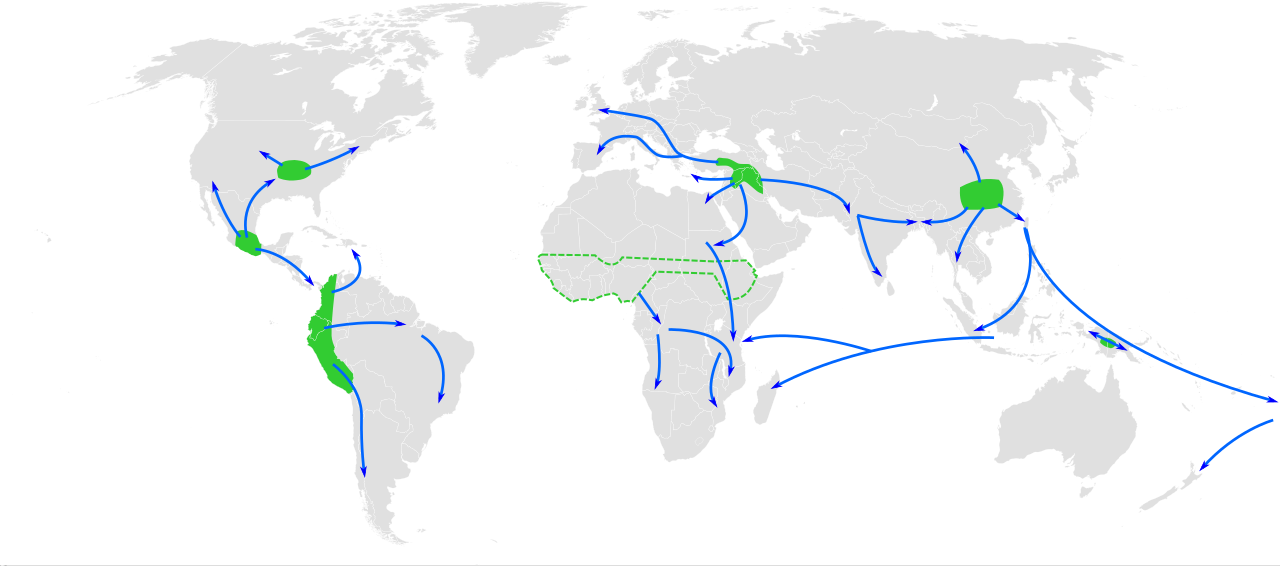
The independent origins of agriculture. Seven separate centres of domestication, spread across four continents, converging on the same transition within a span of roughly five thousand years. The geographic distribution reflects the distribution of wild progenitor species and the environmental conditions of the post-glacial world.
• • •Gobekli Tepe was buried deliberately around 8,000 BC. No one knows why.
Gobekli Tepe and the Question of Sequence
In 1994, the German archaeologist Klaus Schmidt began excavating a site on a hilltop in the Taurus Mountains of southeastern Turkey, near the city of Sanliurfa. What emerged over the following two decades shattered the standard account of the agricultural transition.
Gobekli Tepe, meaning Potbelly Hill in Turkish, consists of at least twenty circular enclosures, each containing T-shaped limestone pillars up to 5.5 metres tall and weighing up to 10 tonnes, arranged in pairs at the centre and ringed by smaller pillars. The pillars are carved with animals of extraordinary variety and precision: foxes, boars, snakes, cranes, ducks, vultures, gazelles, aurochs. Some carry abstract symbols. Some have arms carved along their sides, suggesting they represent anthropomorphic beings, something between a pillar and a person.
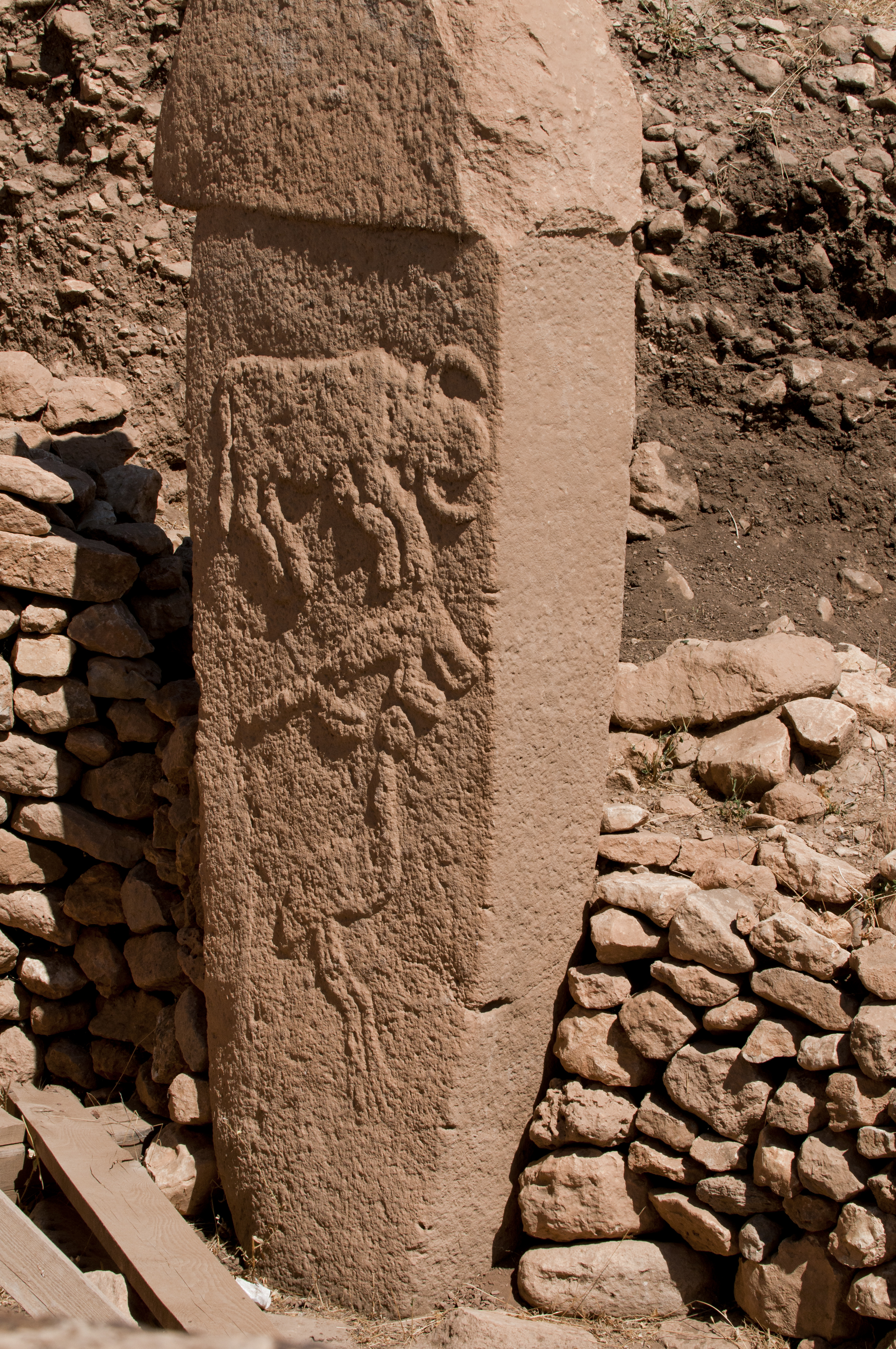
Gobekli Tepe, southeastern Turkey. The T-shaped limestone pillars of Enclosure D, dated to approximately 9,600 BC, are carved with animals of precision and variety that challenges any assumption about the cognitive or organisational capacities of pre-agricultural foragers. The site predates the Great Pyramid of Giza by more than six thousand years.
The site has been dated to approximately 9,600 to 8,200 BC, making it the oldest known large-scale human construction in the world by a very wide margin. The Great Pyramid of Giza dates to around 2,560 BC. Stonehenge was constructed beginning around 3,000 BC. Gobekli Tepe is more than six thousand years older than either.
The difficulty it presents to the standard narrative is this: the surrounding region shows no clear evidence of settled agriculture at the time the site was in active use. The people who built it appear to have been foragers, coordinating the transport and carving of enormous stone pillars across a landscape they were not yet farming.
Schmidt's hypothesis is that Gobekli Tepe reversed the assumed causal sequence. The standard account runs: agriculture produces surplus, surplus allows population concentration, population concentration allows monumental construction. Schmidt argued that the monumental construction came first.
Large ritual gatherings required food in quantities that foraging alone could not easily supply. The management of plant and animal resources to feed those gatherings may have been the pressure that produced the transition to agriculture, rather than its consequence.
The site was deliberately buried, layer by layer, around 8,000 BC. No one knows why. Each enclosure was filled with a mixture of stone debris, animal bones, and worked flint before the next enclosure was built nearby. After several centuries, the entire complex was covered with a thick mantle of debris that preserved it until Schmidt's excavations. The burial was deliberate, careful, and total. The people who did it did not abandon the site. They concluded it.
Whatever Gobekli Tepe was for, it demonstrates that large-scale human coordination preceded settled agriculture rather than following from it. The coordination problem that civilisation is supposed to have solved was being solved, in some form, before the agricultural tools that were supposed to make such solutions possible had been invented.
The Physical Cost
The skeletons tell a different story than the one most people expect.
The work of physical anthropologist George Armelagos and his colleagues, comparing pre-agricultural and agricultural populations across multiple regions, produced findings that remain some of the most important in the archaeology of the Neolithic transition. When populations shifted from foraging to farming in the same geographic regions, the physical record shows consistent deterioration in a set of measurable health indicators.
Average stature in the Fertile Crescent fell by roughly 5 centimetres in the transition to agriculture. Cribra orbitalia, pitting in the roof of the eye socket, a marker of iron-deficiency anaemia, appears with substantially higher frequency in agricultural populations. Rates of dental caries, abscessing, and tooth loss rise sharply. Tuberculosis, brucellosis, and a range of zoonotic infections appear in the archaeological record precisely at the transition to settled life, and intensify as settlements grow.
Average stature declined. In the Fertile Crescent, forager populations preceding the agricultural transition averaged significantly taller than the early farming communities that followed them. Similar patterns appear in North America, where the transition to maize agriculture is associated with measurable reductions in average height across multiple skeletal samples. Stature is a reliable proxy for nutritional status during development: children who receive adequate calories and micronutrients during growth years reach their genetic potential height. Children who are nutritionally stressed do not. The height decline at the agricultural transition is direct evidence that early farmers were less well-nourished during childhood than the foragers who preceded them.
Dental health deteriorated sharply. Caries, tooth decay, is almost absent in forager populations whose diets include relatively little fermentable carbohydrate. Agricultural diets, concentrated in starchy grains, provided exactly the substrate that bacteria require to produce the acids that decay enamel. Severe dental disease in a world without dentistry is a significant source of pain, infection, and mortality.
Infectious disease increased dramatically. The diseases that have killed most human beings across history, smallpox, measles, influenza, bubonic plague, cholera, are diseases of density. They require large, concentrated, settled human populations to maintain transmission. Forager bands, small and mobile, cannot sustain epidemic diseases. The pathogens die out before they can infect enough new hosts. Settled agricultural communities, living in close proximity to their livestock, provided the conditions these diseases required.
Jared Diamond, writing in Discover magazine in 1987 in an essay called The Worst Mistake in the History of the Human Race, synthesised much of this evidence into a provocation that has framed the debate ever since. Diamond's argument is not that agriculture was a mistake in any meaningful sense. It is that the standard progressive narrative of human history, in which agriculture represents an unambiguous advance from a brutish earlier state, is simply inconsistent with the physical evidence. The transition made possible the cities, writing, science, and technologies that the reader inhabits today. It did so by extracting a significant cost from the individuals who made it.
This is the first turn of the coordination problem at the heart of this curriculum. The solution to one problem, how to produce enough food for a growing and concentrated population, created conditions that made the next set of problems inevitable. Surplus concentration produced inequality. Disease pressure produced demographic catastrophe. The response to each produced the conditions for the next.
The skeletons of early farmers are shorter than those of the foragers who preceded them. The surplus went somewhere else.
James C. Scott and the Grain State
The most powerful and unsettling argument about the Neolithic Revolution to emerge from recent scholarship comes not from an archaeologist or a physical anthropologist but from a political scientist. James C. Scott, whose career has been devoted to understanding how states see and control populations, published Against the Grain in 2017, building on earlier work in Seeing Like a State published in 1998. His argument inverts the standard account in a way that, once understood, makes the standard account very difficult to accept.
The standard account runs as follows: agriculture produced surplus; surplus allowed population concentration; population concentration produced cities; cities produced states. In this account, the state is the natural culmination of the agricultural process. Scott's argument is almost exactly the reverse. States did not simply emerge from agriculture. States actively promoted specific forms of agriculture because those forms made states possible, and specifically because they made taxation possible.
His central analytical tool is the concept of legibility. A state can only extract resources from populations it can see and measure. And the decisive question about any food production system, from the perspective of a nascent state apparatus, is not how productive it is but how legible it is.
Grain is uniquely legible. It grows above ground, where it can be surveyed. It ripens at a predictable and relatively concentrated time. It can be stored and transported, moved to central collection points. It can be converted into standard units. Every feature of grain agriculture corresponds to a feature a tax-collecting state requires.
Compare this to root crops. Potatoes, cassava, yams, and similar plants can be left in the ground after ripening and harvested piecemeal over weeks or months. There is no single harvest moment that a tax collector can observe and measure. The crop is underground and therefore invisible to surveillance. From the perspective of a state trying to extract a reliable surplus, root crops are nearly useless. They are, in Scott's phrase, a fiscal nightmare.
Scott's implication is striking: the geographic distribution of grain agriculture versus root crop agriculture may reflect not only environmental conditions and agronomic properties but also the reach and nature of early states. Where states were strong, grain cultivation was promoted, sometimes coercively. Where states were weak or absent, root crops and diverse polycultures persisted. The dietary staples of different civilisations may partly be a map of political power rather than just of agricultural possibility.
Scott goes further. He argues that many people, across the ancient world, were not passive recipients of the agricultural transition. They fled it. The non-state spaces that surrounded early agrarian states, the hills, the swamps, the forests, the deserts, were populated partly by people who had moved away from state control. Scott calls these groups Zomians, and argues that their physical remoteness from state power was not a sign of backwardness but often a strategic adaptation to avoid extraction.
The evidence from early Mesopotamian states supports this reading in suggestive ways. Early Sumerian city-states record declining agricultural productivity not because soil fertility collapsed but because the farming populations that supported them were leaving. The walls of early Mesopotamian cities may have been designed partly to keep people in as much as to keep enemies out.
Scott's critics raise legitimate objections. The evidence for deliberate state promotion of grain over other crops is often inferential rather than direct. The binary between grain states and non-state root-crop cultivators is too clean. But the core analytical move, asking not just what agriculture made possible but what specific agricultural forms made states possible, and then asking who benefited from that specificity, is one of the most productive questions in the entire literature.
Surplus and Its Consequences
When a community begins producing more food than it needs for immediate survival, a set of consequences follows with something close to logical necessity. Not all of these consequences are visible in advance. None of the people participating in the transition made a decision to create them. They are, in the language of systems thinking, emergent properties of the new configuration.
The first consequence is specialisation. If not everyone needs to farm, then some people can do other things. The potter, the weaver, the metalworker, the priest, the soldier, the scribe, none of these figures can exist in a community where every adult spends every productive hour acquiring food. The surplus is what makes them possible. And their existence in turn increases the productivity of the farming community: better tools, better storage, better organisation, better defence. The specialisation becomes self-reinforcing.
The second consequence is inequality. Surplus must be stored somewhere and managed by someone. The person who controls the granary controls access to life in a community that depends on stored grain through the winter. The accumulation of power around the control of surplus is not an accident or an abuse. It is an almost mechanical consequence of having surplus to control. The archaeological record shows the emergence of inequality, visible in differences in burial goods, house size, and diet between individuals in the same community, in direct association with the transition to agricultural surplus.
The third consequence is the city. V. Gordon Childe, writing in the 1950s, proposed a set of criteria that remains useful. A city is a settlement large enough that its residents cannot all know each other personally. In a village of a few hundred people, every adult knows the history, the character, and the current circumstances of every other adult. Reputation functions as the primary mechanism of social control and cooperation. When a settlement grows beyond a certain size, roughly 150 people according to the anthropologist Robin Dunbar's estimate of the limit of stable social groups, that mechanism begins to fail. Coordination among strangers requires new technologies: shared symbols of authority, written records, laws, markets, currencies, institutions. The city is not a bigger village. It is a qualitatively different coordination problem.
Uruk in ancient Mesopotamia, with a population estimated at around 40,000 by 3,000 BC, was the first city in the sense of requiring institutional solutions to the problem of coordinating strangers at scale. The administrative tablets found at Uruk are the oldest known written documents in the world. They are grain receipts. This is not coincidence. They are grain receipts because the coordination problem that writing was invented to solve was the tracking of grain obligations across the scale and complexity of a city economy. The city created writing, and writing created the possibility of administration, law, and the state as a sustained institutional structure rather than a simple exercise of personal authority.
Jared Diamond and the Geography of Luck
No account of the Neolithic Revolution would be complete without engaging with Jared Diamond's argument in Guns, Germs and Steel, published in 1997 and still one of the most widely read books in the entire field of historical macrosociology.
Diamond's question is one of the most important and contested in all of history: why did the civilisational complex that emerged in Eurasia, and eventually in Europe specifically, come to dominate the rest of the world by 1500 AD? The conventional answers have often been some version of cultural or intellectual superiority. Diamond rejects these explanations entirely and replaces them with a geographic determinism that is simultaneously more generous and more disturbing.
His central argument concerns the orientation of continental axes. Eurasia runs primarily east to west. The Americas and Africa run primarily north to south. Crops and domesticated animals spread most easily across similar latitudes, because latitude determines day length and climate. A crop developed in one part of the Fertile Crescent can spread across the same latitude to Central Asia and eventually to China relatively easily. A crop developed in Mesoamerica faces a different problem: to spread north or south, it must pass through dramatically different day-length and climate conditions. Maize took thousands of years to spread from Mesoamerica to North America, partly because of this latitudinal barrier.
The same logic applies to domesticated animals. Eurasia had, by a considerable margin, the largest number of large mammals susceptible to domestication: cattle, horses, sheep, goats, pigs. These animals provided not only food and transport but, crucially, disease. Human populations living in close proximity to large domesticated animals developed immune responses to the diseases those animals carried. The demographic collapse of Indigenous American populations after European contact was driven overwhelmingly by disease: smallpox, measles, influenza. This was the consequence of ten thousand years of Eurasian zoonotic disease pressure producing immune populations that encountered immune-naive populations for the first time.
Diamond's argument is a genuine contribution to the historical literature. It provides a coherent, evidence-based account of global inequality that does not require any assumption about differential human capacity. But Diamond's critics, and they are numerous and serious, have identified real limitations. Daron Acemoglu and James Robinson, writing in Why Nations Fail, argue that geography cannot explain the dramatic divergence in development outcomes between populations in similar geographic situations: North Korea and South Korea, the United States and Mexico, Botswana and Zimbabwe. Institutions, they argue, matter more than geography in explaining contemporary differences.
The truth is probably that Diamond identified a real and important set of constraints without identifying the complete causal story. Geography shaped the initial distribution of domesticable species and determined which populations had centuries of exposure to zoonotic diseases. Those initial conditions mattered enormously. They did not determine everything. Geography set the initial conditions. People made the history.
Diamond's geography set the initial conditions. People made the history.
Catalhoyuk and What Settlement Did Not Require
Before the grain-extracting state consolidated around the agricultural surplus, what did settled life actually look like? The site of Catalhoyuk in the Konya Plain of central Turkey, occupied from approximately 7,500 to 5,700 BC, provides the most detailed window available into an early agricultural settlement before the emergence of centralised authority.
At its peak, Catalhoyuk housed somewhere between 3,500 and 8,000 people, making it one of the largest known settlements of its era. By any reasonable measure it was a town rather than a village, yet it defied almost every expectation about what a settlement of that scale would require.
There were no streets. Houses were built directly against each other, their outer walls forming the outer boundary of the settlement with no gaps between them. Access to individual houses was through holes in the flat roofs. Residents climbed in and out by ladder. Movement across the settlement meant moving across rooftops.
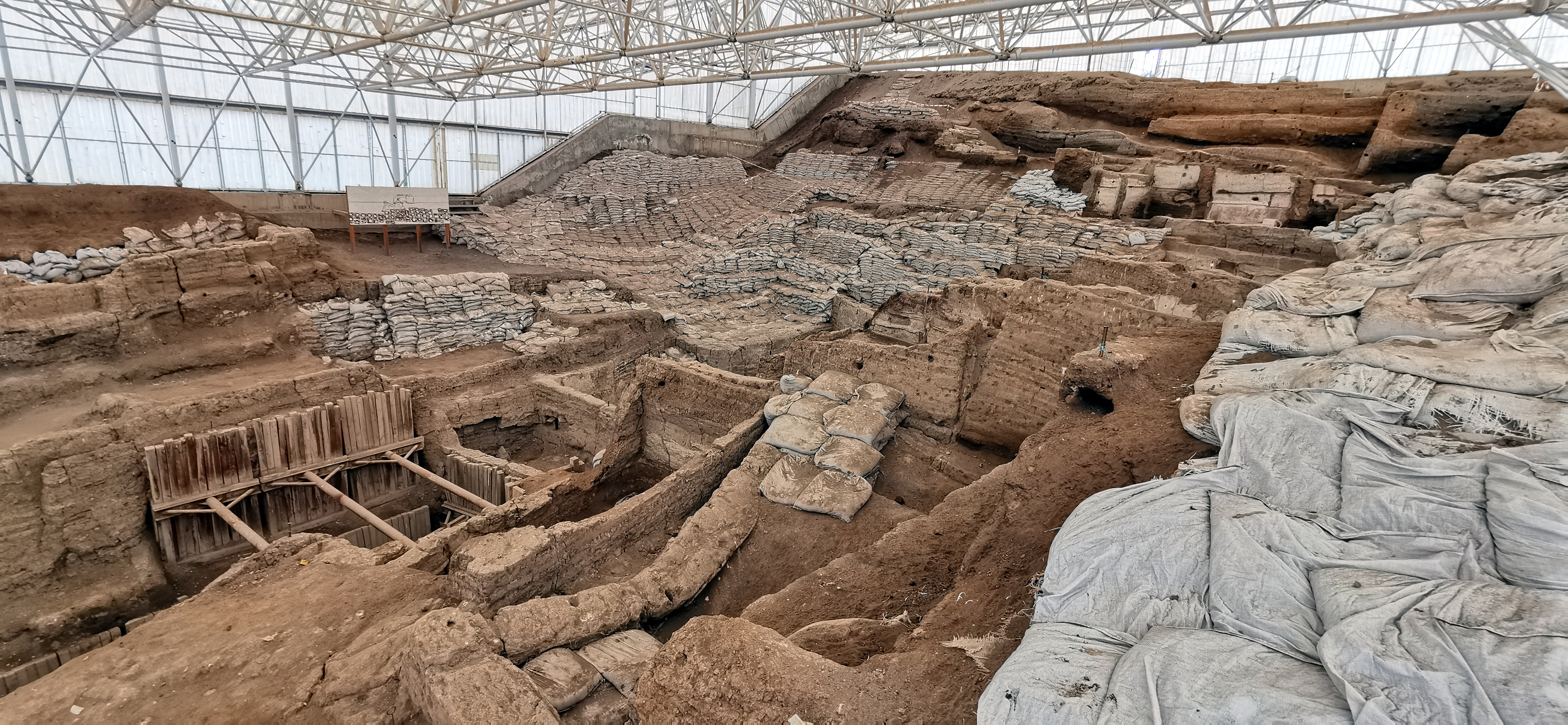
Catalhoyuk in the Konya Plain of modern Turkey. Occupied from approximately 7,500 to 5,700 BC. A settlement of up to 8,000 people with no streets: houses were built directly against each other and entered through holes in the roof. No evidence of a central authority, a palace, a temple, or a ruling class in the early layers. What this tells us about the range of social forms that early settlement could take before the state consolidated around the grain surplus.
There was no evidence, in the early layers of the site, of a central authority. No palace. No temple complex of the kind that dominated later Mesopotamian cities. No burial area reserved for an elite. The burials found at Catalhoyuk are located beneath the floors of ordinary houses, and the burial goods accompanying them show relatively little differentiation in the early periods. The archaeologist Ian Hodder, who has led excavations at the site since the 1990s, has argued that the absence of centralised authority suggests that the coordination problems of a town-scale settlement were being solved through mechanisms other than institutional hierarchy.
Shared ritual practice is one candidate: the walls of Catalhoyuk houses are covered with repeated ritual imagery, wild bull heads, geometric patterns, scenes of hunting and vultures. The uniformity of ritual practice across hundreds of individual households may have served as a coordination mechanism, producing shared norms and expectations that reduced the need for formal authority.
Catalhoyuk held thousands of people in a relatively egalitarian configuration for nearly two thousand years. The emergence of centralised authority was not automatic. It was a further development, with its own preconditions and its own logic.
The site provides a crucial corrective to any simple narrative in which settlement automatically produces stratification. What Catalhoyuk shows is that the range of possible responses to the coordination problems of settled agricultural life was wider than the institutional forms that eventually came to dominate the archaeological record would suggest.
The Chain Begins
The Neolithic Revolution is not a story with a clean ending. It is the opening chapter of a much longer narrative, and its consequences are still unfolding.
The transition to agriculture, occurring independently in at least seven regions over a span of five thousand years, was not chosen in any meaningful sense by the individuals who participated in it. It was the cumulative product of millions of incremental decisions, each made in response to immediate local conditions, none of them visible as part of a larger transformation. No one in the Fertile Crescent of 9,500 BC decided to invent civilisation. They decided to plant seeds near a favoured water source, to tend a stand of wild wheat, to keep rather than slaughter a wounded wild goat. The transformation was the aggregate of those decisions, propagating across time and space in ways no individual participant could foresee.
The costs were real. The skeletal evidence is not in dispute: early agricultural populations were shorter, sicker, more nutritionally deficient, and more subject to epidemic disease than the foragers they replaced. The surplus they produced was not primarily a gift to themselves. It was a resource that, over the following millennia, would be captured by states and extracted by elites in ways that perpetuated and deepened the inequalities the surplus itself had created.
The chain runs unbroken from the first grain stores of ancient Mesopotamia to the institutions the reader inhabits today. Every link in that chain was forged to solve a problem created by the previous link. Understanding where it started is the precondition for understanding everything that followed.
And yet the surplus also made everything else possible. The specialisation that comes from not having to farm makes possible the priest, the soldier, the scribe, the merchant, the philosopher, the scientist, the engineer. The concentration of population makes possible the city, the market, the law court, the school, the library. The writing invented to track grain obligations becomes the medium in which Homer writes the Iliad and Newton writes the Principia. The coordination problem that the city creates, how to manage the cooperation of strangers at scales too large for personal acquaintance to sustain, generates the institutional technologies, law, money, the state, that are the subjects of the remaining artifacts in this curriculum.
The chain runs unbroken from the first grain stores of ancient Mesopotamia to the institutions the reader inhabits today. Every link in that chain was forged to solve a problem created by the previous link. Understanding where it started, understanding what was gained and what was paid, is the precondition for understanding everything that followed.
The soil was turned. The seeds went in. Something that had never existed before was beginning to grow.