Writing
and the
State
circa 3,400 BC
Scroll to begin
The first artifact ended with a city and a surplus. This one begins with the problem that surplus creates.
How do you track obligations across time and distance, at a scale too large for memory alone to manage? The answer that emerged in Mesopotamia around 3,400 BC was not poetry. It was not philosophy. It was not the recording of history. It was a list of grain quantities and the names of the people who owed them. Writing did not begin as an act of expression. It began as an act of administration. That origin shapes everything the technology eventually became.
The Myth of Writing
Every literate person carries an implicit story about why writing was invented. The story usually involves human beings wanting to record their thoughts, preserve their literature, communicate with people far away, or pass knowledge across generations. These are the uses of writing that feel most significant today, and so it is natural to assume they are the uses writing was invented for.
They were not.
The actual record is unambiguous and has been for decades, since the decipherment of the earliest Sumerian tablets in the mid-twentieth century. The oldest written documents in the world are not stories, hymns, or records of battles. They are lists. Lists of grain quantities. Lists of livestock. Lists of workers and their rations. Lists of debts owed and payments received. The earliest writing is, without exception, economic administration. It is paperwork. The bureaucrat precedes the poet by something in the order of a thousand years.
This is not a minor historical curiosity. It is an argument about the relationship between information technology and social organisation. Writing did not emerge because human beings desired self-expression and found a new way to achieve it. Writing emerged because a specific social institution, the complex redistributive economy of the Mesopotamian city-state, generated an information management problem that the human brain, operating on memory and oral communication alone, could not solve at the required scale. The technology was a response to an institutional pressure. It was made by the needs of the state before the state had the name.
Understanding where writing came from does not diminish it. It deepens the astonishment. The tool that produced the Iliad, the Quran, the Principia Mathematica, and every other written work the reader has encountered began as an administrative fix. The path from grain receipt to tragedy is one of the most extraordinary developments in the history of the species. It requires explanation.
Uruk and the First Writing
The city of Uruk in the southern alluvial plain of Mesopotamia, in what is now southern Iraq, was by 3,500 BC one of the largest human settlements that had ever existed. Its population at the height of the Uruk period, roughly 3,500 to 3,100 BC, may have reached 40,000 people within the city walls and considerably more in the surrounding agricultural hinterland. Nothing like it had existed before on earth.
A city of that scale faced a problem that smaller settlements had not needed to solve. It collected grain, oil, wool, and other commodities from a large agricultural hinterland. It redistributed those resources to specialists, craftspeople, priests, soldiers, and administrators who produced things other than food. It managed large labour forces on public works. It maintained obligations across hundreds of individuals and across time horizons of months and years. A harvest collected in autumn had to be tracked through to spring. A debt incurred in one season had to be recoverable in another.
Human memory is not equal to this task at that scale. Even highly trained specialists in oral mnemonic techniques can maintain reliable recall across perhaps a few hundred named individuals and their respective obligations. Uruk was dealing with thousands of transactions, thousands of individuals, and an administrative complexity that exceeded any previous institutional structure.
Before writing, the Mesopotamians used clay tokens. Small, shaped pieces of clay, each representing a specific quantity of a specific commodity. These tokens were used in transaction records going back to at least 8,000 BC. They are a one-to-one physical correspondence between a clay object and a real-world quantity.
The solution that emerged was writing, but the path to writing was gradual and moved through several intermediate stages. Before writing, the Mesopotamians used clay tokens. Small, shaped pieces of clay, spheres, cones, cylinders, discs, flat tablets, each representing a specific quantity of a specific commodity. A small cone might represent a unit of grain. A sphere might represent a larger quantity. These tokens were used in transaction records going back to at least 8,000 BC, distributed across a wide area of the ancient Near East. They are, in their simplest form, a one-to-one physical correspondence between a clay object and a real-world quantity.
When quantities became large and transactions complex, the tokens were sealed inside hollow clay balls called bullae. The bulla could be sealed and delivered as a record of a specific obligation: the tokens inside told the recipient what was owed. But there was a problem. To check what was inside the bulla, you had to break it. And once broken, the record was difficult to reconstruct.
The solution was to impress the tokens into the outer surface of the bulla before sealing it, so that the contents were visible without breaking the seal. This is, in retrospect, the decisive moment. Once the impression on the clay surface carried the same information as the tokens inside, the tokens inside became redundant. The surface impression was sufficient. The bulla became a flat clay tablet. The token became a written sign.
The earliest Sumerian writing, dating to roughly 3,400 to 3,100 BC, consists of signs pressed into wet clay with a reed stylus, the clay then dried or fired to preserve the record. The signs are primarily pictographic: a head with a bowl represents food rations; a bull's head represents cattle; a sheaf of grain represents barley. But they are already moving beyond pure pictography. The signs represent quantities and categories in ways that require interpretation rather than mere visual recognition. They are encoding information in a system that requires training to read and write. This is the moment when writing becomes a technology rather than a medium.
The Uruk tablets that survive, several thousand of them, excavated from administrative deposits at the base of the great temple complex, record almost exclusively economic transactions. Rations distributed to workers. Grain received from agricultural estates. Livestock counts. Quantities of fish, dates, and oil. The administrative machinery of a very large redistributive economy, preserved in clay because clay is durable and the ancient Near East is dry.
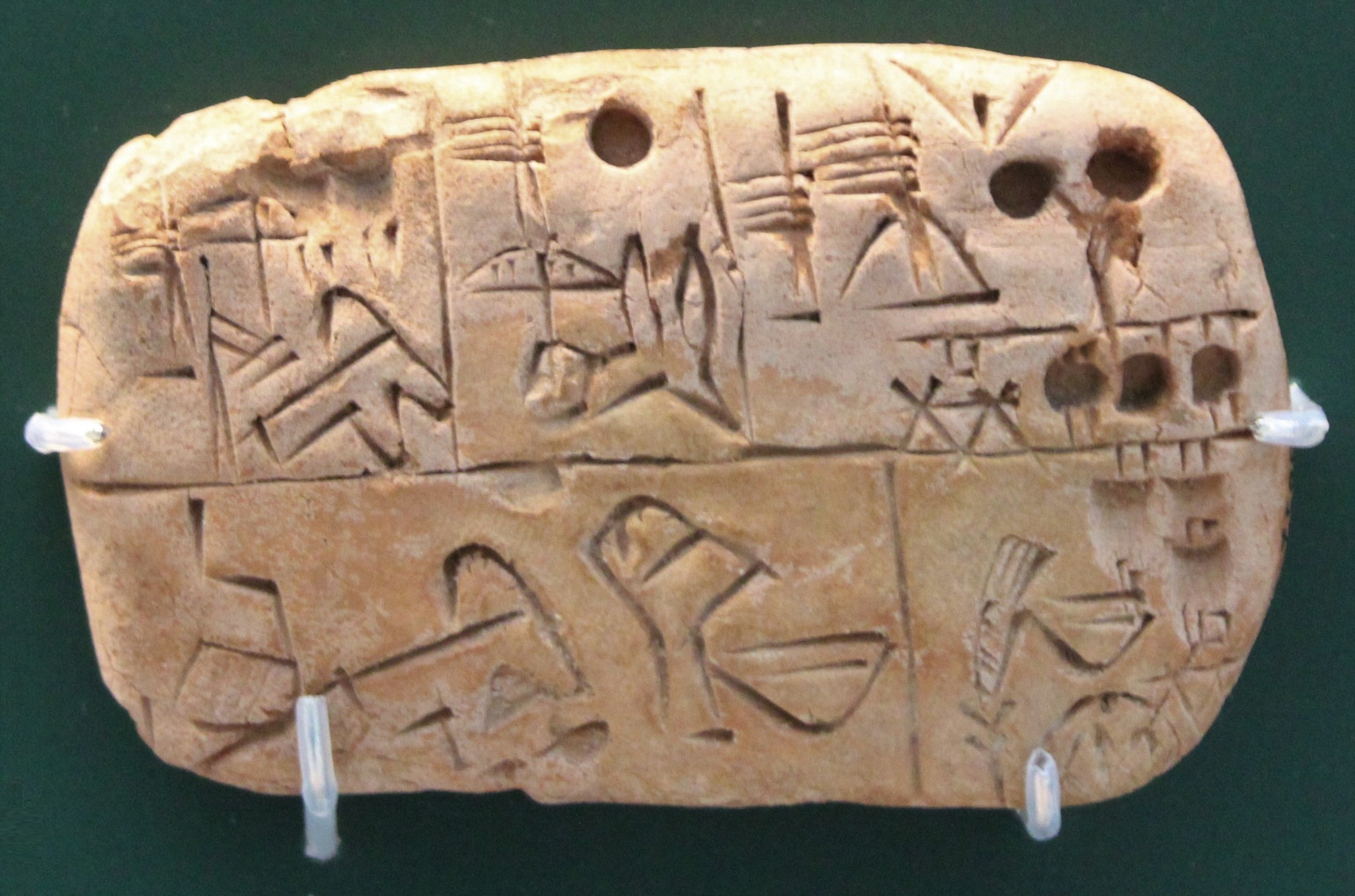
A Sumerian clay tablet from Uruk, circa 3,100 BC, recording the distribution of grain rations. The signs pressed into the wet clay are among the oldest written documents in the world. They are not literature. They are administration.
The scribe did not record the world. The scribe recorded what the institution needed to know about the world.
From Accounting to Language
The earliest Sumerian writing could not represent language in any full sense. It could record quantities and categories. It could identify individuals by name, using a combination of signs that suggested the sounds of the name rather than its meaning. But it could not record syntax, verbs, complex relationships, or the kind of connected prose that constitutes communication of ideas.
The transition from this limited administrative recording system to full writing, capable of representing any utterance in the spoken language, took approximately five hundred years. It is one of the most consequential developments in intellectual history, and it happened not because people wanted to write literature, but because the administrative system needed to become more precise.
The key innovation was the rebus principle. In every writing system, at some point, a sign that began as a picture of an object came to be used for its sound rather than its meaning. In Sumerian, the sign for an arrow, ti, came to be used to write the word for life, til, because the two words sounded similar. This allowed the system to escape the limitation of pure pictography. Once a sign can represent a sound rather than a thing, you can build words from combinations of sounds, and words can eventually build anything.
By around 2,800 BC, Sumerian writing could represent connected prose with reasonable fidelity. The first texts that go beyond pure administration appear at approximately this point: royal inscriptions celebrating military victories, dedications to temples, the earliest mythological narratives. The administrative fix had become a civilisational technology.
The scholar Andrew Robinson, in his history of writing, notes something that deserves emphasis: the development of full writing from its administrative origins required a specific kind of social and institutional infrastructure. Writing was not invented by isolated geniuses. It was developed by professional scribes, trained in specialist schools, working within large institutional structures, the temples and palaces of Mesopotamian city-states, that had both the need and the resources to develop and maintain such a system. Writing is, from its very origins, an institutional technology. It exists because institutions needed it. It spread because institutions carried it.
The Scribe and the State
By the third millennium BC, the Sumerian city-states of Mesopotamia had developed a fully elaborated scribal culture with dedicated educational institutions, established curricula, and a professional class whose entire identity and livelihood rested on literacy.
The edubba, or tablet house, was the Sumerian school. Students, predominantly but not exclusively male, attended for years and produced practice tablets that have survived in large numbers in the archaeological record. The curriculum was demanding: students copied lists, the foundation of Sumerian scribal education. Lists of trees and plants. Lists of animals. Lists of professions. Lists of geographical features. Lists of legal terms. Lists of deities. These lists served as both a training exercise and an encyclopaedia, a systematic attempt to catalogue the contents of the known world in a form that could be transmitted reliably across time and between trained readers.
The social position of the scribe in Mesopotamian society was elevated and distinct. A surviving Sumerian text from around 2,000 BC, sometimes called The Edubba Dispute, records a dialogue between a scribe and a farmer in which the farmer claims that farming is more important than literacy, and the scribe responds with a comprehensive enumeration of everything the scribe knows and the farmer does not. The scribe wins. The text is propaganda of a particular kind, produced by and for the literate class, but it reflects a real social reality: in a world where writing was rare and essential, the person who could read and write had access to power that others did not.
Writing did not make society transparent. It made society legible to its institutional managers while remaining opaque to the people those institutions managed.
This asymmetry is worth examining carefully. Writing, in its Mesopotamian origins, was not a widely distributed technology. It was held by a small specialist class and used primarily in the service of large institutional actors: temples, palaces, and the emerging state apparatus. The information encoded in writing was largely inaccessible to the population that the written records described. The grain farmer whose harvest was recorded on a temple tablet could not read the tablet. The obligation it encoded was enforced by an institution, the temple bureaucracy, that controlled the technology of record-keeping entirely.
This is the point where James C. Scott's analysis of legibility, introduced in the first artifact, becomes most acute. Writing did not make society transparent. It made society legible to its institutional managers while remaining opaque to the people those institutions managed. The information asymmetry created by writing was not an accidental side effect. It was one of the primary mechanisms through which early states maintained control.
Cuneiform and Its World
Cuneiform, the wedge-shaped script that emerged from the earliest Sumerian pictographs, became one of the most durable and widely used writing systems in the ancient world. From its origins in Uruk around 3,400 BC, it spread across Mesopotamia and eventually to a wide range of languages, none of which were originally related to Sumerian: Akkadian, Babylonian, Assyrian, Elamite, Hittite, and others. Cuneiform was adapted to these languages in roughly the way that the Latin alphabet has been adapted to dozens of unrelated modern languages. The sign system was flexible enough to be repurposed, and the institutional infrastructure that supported it, the scribal schools, the palace and temple administrations, the specialist class, travelled with it.
The cuneiform record is extraordinary in its scope and detail. It preserves, across the roughly three thousand years of its use from approximately 3,400 BC to the first century AD, everything from royal annals and mythological epics to private letters, commercial contracts, astronomical observations, mathematical tables, medical prescriptions, legal proceedings, and recipes. The Epic of Gilgamesh, one of the oldest known literary works in the world, survived in multiple cuneiform versions across different periods and languages. The Babylonian astronomical records, kept over centuries with remarkable precision, contributed to the development of Greek astronomy and from there to the scientific tradition that produced modern astronomy.
But the administrative function never disappeared, and never became secondary. Throughout the period of cuneiform use, the vast majority of tablets that survive are economic and legal documents. The balance of the cuneiform record is a reminder of what writing was for: not self-expression, but institutional management.
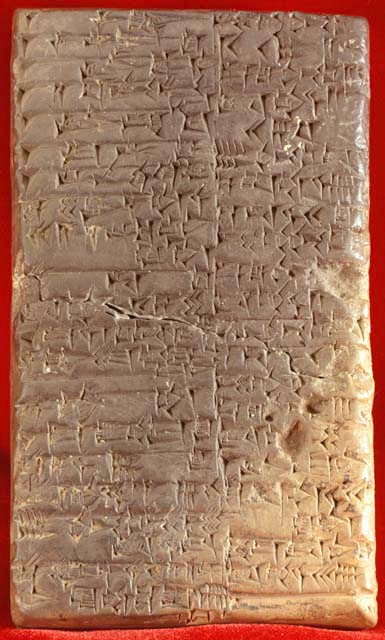
Cuneiform signs in clay. The wedge-shaped impressions made by a reed stylus in wet clay have a physical quality unlike any later writing: they were literally pressed into material, like the weight of an obligation pressed into reality. The script remained in use for approximately 3,000 years.
The physical properties of cuneiform tablets are themselves informative. Clay is heavy, fragile, and available everywhere in alluvial Mesopotamia. Once dried or fired, a clay tablet is extraordinarily durable: many Sumerian tablets survive in better condition than medieval manuscripts written on vellum four thousand years later. The material properties of the medium shaped the institution. Because clay is cheap and abundant, records could be produced in large quantities. Because fired clay is very nearly permanent, records could be preserved across centuries. The combination of cheapness, abundance, and durability made clay the ideal medium for a large-scale administrative system that needed to produce, store, and retrieve records at scale.
The archive was the institutional form that writing made possible. The great temple archives of Nippur and Girsu, the palace archives of Mari and Ebla, hold tens of thousands of tablets each. They are not libraries in the modern sense. They are not organised for access by a reading public. They are record stores, organised for retrieval by trained administrators who knew what they were looking for. The archive is the information technology of the early state: the mechanism by which an institution holds and applies knowledge across time.
Writing was invented by the state. The alphabet escaped it.
Independent Invention and What It Reveals
Writing was not invented once. It was invented independently at least three times, and possibly four, in different parts of the world, by populations with no demonstrable contact with each other.
Sumerian cuneiform emerges in Mesopotamia around 3,400 BC. Egyptian hieroglyphs emerge shortly after, around 3,200 BC, though the relationship between these two systems, whether Egypt received any stimulus from Mesopotamia, or invented independently, remains a contested question among specialists. The weight of evidence currently suggests that the idea of writing may have diffused from Mesopotamia to Egypt, even if the specific signs were invented independently. The gap between stimulus diffusion and independent invention is, in this case, genuinely unclear.
The Indus Valley script, associated with the Harappan civilisation that flourished in modern Pakistan and northwestern India from roughly 2,600 to 1,900 BC, is entirely independent. It has not been deciphered. It appears primarily on small stamp seals used in what seems to have been a commercial context. Its relationship to the later writing traditions of the Indian subcontinent is unclear. It may be a completely separate invention that died with the civilisation that created it.
The Chinese script, emerging in the Shang dynasty around 1,200 BC on oracle bones used for divination, is almost certainly independent of all other traditions. Chinese writing developed from a base of pictographic signs into a complex logographic system that combined meaning-bearing and sound-bearing elements. It is the only ancient writing system still in recognisable use today.
The Mesoamerican writing systems, including the Mayan script that emerged around 300 BC and eventually achieved full representation of spoken language, are entirely independent of all Old World writing traditions. The Mayan script is one of only a handful of writing systems ever invented that could represent any utterance in the spoken language with complete fidelity. It was deciphered only in the latter half of the twentieth century, and only after decades of scholarly debate about whether it was a phonetic, logographic, or purely symbolic system. It is all three simultaneously.
The pattern of independent invention reveals what the Neolithic pattern of independent agricultural invention already suggested: when the social conditions that create a problem reach a certain threshold of complexity, the solution space is constrained. Writing, in its various forms, is a particular kind of solution to a particular kind of problem, and that problem, managing information at institutional scale, seems to arise under conditions that have appeared independently in multiple times and places. The specific form of the solution differs. The underlying function does not.
The Evolution of Writing Systems
Independent origins, approximate active periods, and relative longevity
Writing was not invented once. The independent emergence of writing in at least three separate locations, each producing a functionally similar solution to a functionally similar problem, suggests that the conditions for writing, not the cultural impulse for self-expression, drove its invention. The alphabet, when it finally arrived, spread through commercial networks rather than through state promotion. Its learning burden was weeks rather than years.
Egypt, Administration, and the Alternative Path
Egypt provides the closest contemporary comparison to Mesopotamia, and the comparison is illuminating precisely because the two systems, despite emerging in the same general period and developing roughly parallel administrative complexities, produced writing systems that look very different and were used in partially different ways.
Hieroglyphic writing, the elaborate pictographic script associated with pharaonic Egypt, is one of the most recognisable visual systems in the ancient world. But the elaborate hieroglyphs carved into temple walls and royal monuments were not the primary form in which most Egyptian writing was produced. Alongside hieroglyphs, the Egyptians developed hieratic, a cursive script written with reed brush on papyrus, and later demotic, an even more abbreviated cursive form. The administrative and commercial writing of everyday Egypt was done in these cursive scripts, not in the formal hieroglyphs of the monuments.
This distinction matters because it illuminates a feature of early writing systems that tends to be obscured by the monumental record: the system that appears in the archaeological record most visibly is often not the system in which most writing was done. Temple inscriptions and royal cartouches survive because they were carved in stone. The administrative papyri of everyday Egypt are far rarer, because papyrus is less durable than stone. The archive of Egyptian administrative writing that has been lost to time may have been larger than the archive that survives.
What the Egyptian case adds to the picture of writing's function is the explicit connection between writing and royal power. The earliest Egyptian writing, in the period immediately before and after the unification of Upper and Lower Egypt around 3,100 BC, is almost exclusively associated with royal and administrative contexts. Labels identifying goods sent as tribute to the royal court. Records of royal expeditions. Identification of the king. The Egyptian state appears to have used writing from its very earliest phase as a technology of royal assertion, inscribing the identity and power of the pharaoh onto objects and places with a thoroughness that the Mesopotamian city-states, with their more complex and distributed power structures, did not quite replicate.
The pyramids themselves are administrative documents of a kind. The precision with which millions of stone blocks were quarried, transported, and assembled was a logistical achievement that required extensive written records, plans, lists of workers and their rations, the same kind of administrative machinery that appears on the Uruk tablets. The pyramids did not build themselves. They were built by a writing-enabled state.
Writing and Power: What the Technology Does to Society
Writing is sometimes described as a neutral technology, a tool that can be used for any purpose and whose effects depend entirely on how it is deployed. This is not quite right. Writing has structural properties that tend to produce certain kinds of social effects regardless of the intentions of its users.
The first structural property: information asymmetry
A community in which some people can read and write and most cannot is a community in which the literate minority has access to a kind of power that is qualitatively different from physical or even economic power. The literate minority can encode obligations, maintain records, communicate across distances, and accumulate knowledge across generations in ways that the illiterate majority cannot independently verify or contest. The temple scribe who records the grain debt of a farmer controls the record. The farmer cannot check it. This asymmetry was structurally reproduced across every early literate civilisation, and it persisted until literacy became widespread enough to be democratic in a meaningful sense.
The second structural property: institutional memory
An oral culture's institutional memory is limited by the memory and lifespan of its members. Knowledge that is not continuously transmitted across generations is lost. Writing creates the possibility of an institutional memory that is, in principle, unlimited. Records can be stored, retrieved, and referenced across time scales that far exceed individual lifespans. This makes possible a qualitatively different kind of institution, one that can accumulate precedent, enforce historical obligations, maintain complex systems of law, and coordinate action across very large numbers of people who have never met and never will.
The third structural property: the logic of the list
The anthropologist Jack Goody, in his 1977 book The Domestication of the Savage Mind, described what he called the logic of the list. Written lists have properties that oral enumeration does not. A list can be scanned, sorted, searched, compared, and extended in ways that an oral recitation cannot. The organisation of information in written form, in categories and hierarchies and tables, shapes the categories of thought available to the people who use that information. Goody's argument, which has been influential and contested in roughly equal measure, is that literacy tends to produce certain ways of organising knowledge, certain habits of abstraction and categorisation, that have specific cognitive consequences. The underlying observation, that the technology through which information is organised shapes what kinds of thought become habitual and natural, is difficult to dismiss.
The fourth structural property: distance command
Before writing, complex coordination across physical distance was limited by the capacity of messengers to accurately recall and transmit oral messages, and by the difficulty of verifying authenticity. Writing allowed instructions, contracts, and authoritative commands to travel without their originator. The decree of a king in a capital city could reach an administrator in a distant province and be enforced there with the authority of the king, even though the king had never visited. The empire, which is the subject of the third artifact in this curriculum, depends on writing in a fundamental sense: an empire is, among other things, a writing-enabled coordination mechanism extended across very large distances.
The Alphabet and the Democratisation of Writing
The writing systems that emerged in Mesopotamia and Egypt were complex. Cuneiform, at its height, comprised several hundred distinct signs. Egyptian hieroglyphs, in their full formal expression, used several thousand. These systems required years of specialised training to master and were therefore, necessarily, the province of a small specialist class. Their complexity was partly a consequence of their pictographic origins and partly, as some scholars have argued, a deliberate feature maintained by scribal guilds with an interest in preserving the exclusivity of their expertise.
The alphabet changed this. The alphabetic principle, in which a small set of signs represents the sounds of a language rather than its words or meanings, reduces the learning burden from years to weeks. A literate adult learning a new alphabetic script can typically achieve functional reading ability in a short period. The same adult learning cuneiform from scratch would require years.
The alphabet was invented once, in the Levant, somewhere around 1,800 to 1,600 BC, probably in a population familiar with Egyptian hieroglyphs and Akkadian cuneiform but not fully integrated into either scribal tradition. The Proto-Sinaitic script, found in a small number of inscriptions from the Sinai Peninsula and the Levant dating to around 1,900 to 1,700 BC, appears to be the closest known ancestor of all alphabetic writing systems. From this single invention, every alphabetic script in use today descends: Phoenician, Hebrew, Aramaic, Greek, Latin, Arabic, Cyrillic, and the dozens of scripts derived from them. The alphabet is, in terms of its historical influence, one of the most consequential inventions in the history of the species, and it spread not because states promoted it but partly because it was useful for private commercial communication in a way that the cumbersome palace and temple scripts were not.
The Phoenicians, maritime traders active across the Mediterranean from roughly 1,200 BC onward, used the alphabet as a commercial tool. Merchants needed to record transactions quickly, in a system that required minimal training and was legible to trading partners from different language backgrounds. The alphabet served this function far better than cuneiform or hieroglyphic traditions. It spread through commercial networks rather than through the institutional infrastructure of states, and this meant it spread without the social controls that scribal cultures maintained over earlier writing systems.
The Greeks adapted the Phoenician alphabet around 800 BC, adding vowel signs that the Semitic alphabets had not included. The Greek adaptation is, in retrospect, what allowed the alphabet to penetrate civic and literary culture in the way it did. A script that records vowels can represent the spoken language with sufficient fidelity to allow poetry, drama, and philosophy to be written, read aloud from a written text, and performed from a script. Greek literacy was not democratic in the sixth and fifth centuries BC, most Athenians remained illiterate or only partially literate. But the conditions for a reading public were being created, and those conditions would eventually produce institutions, the library, the public inscription, the published law, the private letter, that depended on a literate population rather than a literate specialist class.
The library was possible because writing existed. It existed because an institution decided to build it.
The Archive, the Library, and the Long Memory
The great Library of Alexandria, founded in the early third century BC under Ptolemy I and expanded under his successors, represents the fullest early expression of what writing made possible when its institutional application was turned toward knowledge accumulation rather than administrative management.
The library was not simply a large collection of scrolls. It was an attempt, seriously pursued, to collect every text produced in the Greek-speaking world and to use those texts as the basis for systematic scholarship. The Alexandrian scholars who worked there in the third and second centuries BC produced, among other things, critical editions of Homer, systematic commentaries on earlier texts, the first grammatical descriptions of the Greek language, contributions to mathematics, astronomy, geography, and medicine, and a body of scholarship that shaped the transmission of ancient knowledge through the medieval period and into the modern world.
The library was possible because writing existed. But it was also possible because a specific institutional context, the Ptolemaic court, with its interest in projecting cultural prestige and its resources to fund large-scale intellectual projects, created the conditions for such an institution. The library did not emerge spontaneously from the existence of writing. It emerged because an institution decided to build it.
Writing and the state co-created each other. The state created writing, in the sense that the administrative needs of the early city-state generated the pressure that produced the first writing systems. Writing created the state, in the sense that only a writing-enabled institution could project authority across the distances and complexities that make a state rather than a city.
This is a consistent pattern in the history of writing. The technology enables; it does not determine. Whether a given society uses writing to extend state control, to accumulate knowledge, to enable commerce, or to produce literature depends on the social and institutional context in which writing operates. Sumerian cuneiform was used primarily to manage the redistributive economies of city-states. Egyptian hieroglyphic writing was used primarily to assert royal power and maintain temple institutions. Phoenician alphabetic writing was used primarily to facilitate long-distance commerce. Greek alphabetic writing was used for all of these things and also for the production of literature, philosophy, and systematic inquiry. The technology was the same in each case. The institutional contexts were not.
And the institutional context that most consistently shaped what writing could and could not do was the state. The state created writing, in the sense that the administrative needs of the early city-state generated the pressure that produced the first writing systems. The state was the primary employer of scribes for most of writing's early history. The state determined who was trained to read and write and who was not. The state maintained the archives that made institutional memory possible. And the state used writing to extend its reach across populations, territories, and time scales that would have been administratively impossible without it.
Writing and the state co-created each other, and the product of their co-creation is the world that the reader inhabits today: a world of documents, records, archives, and obligations encoded in text, managed by institutions, and enforced by states. The grain receipt from Uruk is the ancestor of every contract, law, and binding record in that world. It is, in its small clay way, the beginning of the written world.