Stars, Galaxies, and the Forging of Elements
The atoms in a living body were not always here. They were assembled across billions of years inside stars that burned and died before the Sun existed. This is the story of how that happened.
Every atom heavier than lithium was forged inside a star. Not metaphorically. Literally.
The Big Bang produced only hydrogen, helium, and traces of lithium. Everything else on the periodic table, every element that makes chemistry complex enough to support life, arrived later through stellar nucleosynthesis.
The Debt We Owe to Dying Stars
Begin with the most extraordinary fact in all of science: every atom in the body heavier than lithium was forged inside a star. The carbon bonded into every molecule of DNA, the oxygen being breathed, the calcium in every bone, the iron carrying oxygen through every bloodstream were assembled through nuclear reactions in stellar interiors and dispersed into space when those stars died.
The Big Bang, covered in Artifact I, produced only three elements in any significant quantity: hydrogen, helium, and traces of lithium. That is the complete inventory of the early universe. Everything else on the periodic table, every element that makes chemistry complex enough to support biological molecules, arrived later through stellar nucleosynthesis: the process by which nuclear reactions in stellar cores fuse lighter nuclei into heavier ones and release the energy that makes stars shine.
This was not known until 1957. In that year, four astrophysicists published a 104-page paper in Reviews of Modern Physics that changed that permanently. E. Margaret Burbidge, Geoffrey Burbidge, William Fowler, and Fred Hoyle, now known collectively as B2FH, identified eight distinct nuclear processes operating in stellar interiors and during stellar explosions, and showed how each process contributed to the abundance pattern of the elements observed across the universe. It is one of the greatest achievements in the history of science. Its central claim is now as well-confirmed as anything in physics: the elements were made in stars.
Understanding this requires understanding how stars work, how they are born, how they live, and why their deaths are not endings but dispersions. The atoms in the reader's body have been inside at least one star, possibly more. They were processed in a nuclear furnace operating at millions of degrees, fused from simpler elements by reactions that have been running the universe's chemistry for thirteen billion years.
The Birth of Stars: Gravity's Patient Work
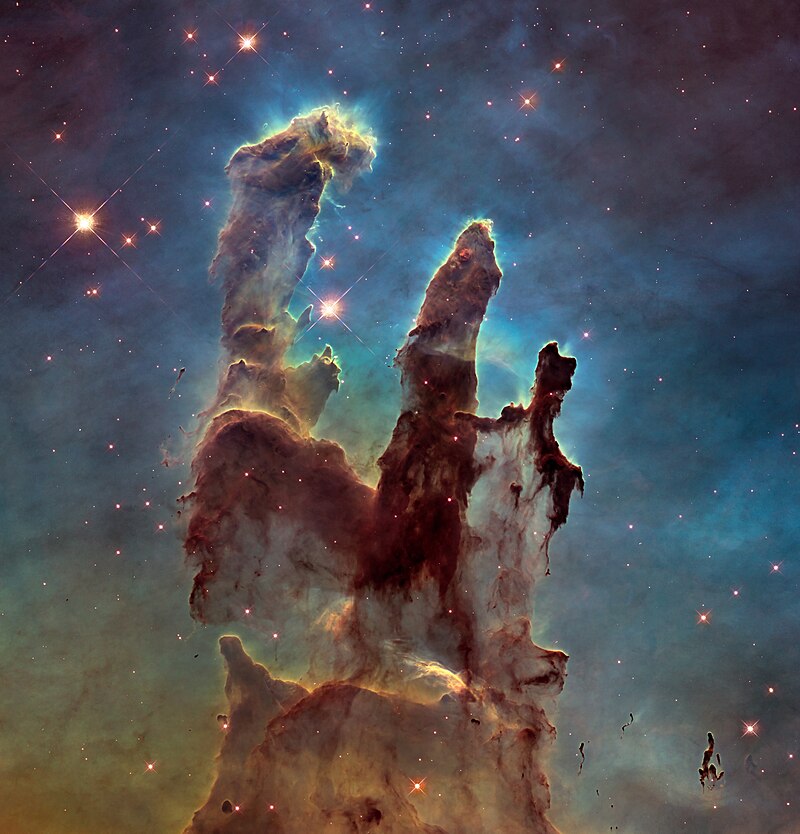
Stars are not born from nothing. They are born from the material that previous stars left behind. The interstellar medium, the gas and dust filling space between stars, is the repository of everything stellar nucleosynthesis has produced. New stars form from this material, process it further, and return it to the medium when they die. The universe recycles.
The interstellar medium is predominantly hydrogen and helium, in approximately the ratio set by the Big Bang: roughly 75 percent hydrogen by mass, 24 percent helium, and around 1 to 2 percent everything else. That 1 to 2 percent is the accumulated product of all stellar nucleosynthesis since the first stars ignited approximately 200 million years after the Big Bang. In the early universe, that fraction was essentially zero. It has been building ever since, as successive stellar generations have processed hydrogen and helium into heavier elements and returned them through planetary nebulae and supernova explosions.
Within the interstellar medium, denser regions called molecular clouds exist: vast accumulations of gas and dust, cold by astronomical standards, typically 10 to 30 Kelvin, where hydrogen exists in molecular form and where density is high enough for molecules to survive without being dissociated by ultraviolet radiation. The collapse of a molecular cloud into stars is initiated when the gravitational potential energy of a region exceeds the thermal energy resisting it, a threshold formalised mathematically by the British physicist Sir James Jeans in 1902. The Jeans mass is the minimum mass a region of gas must have, at a given temperature and density, for gravity to overcome thermal pressure and initiate collapse.
Collapse is not instantaneous. A free-falling cloud at molecular cloud densities takes millions of years to reach stellar densities. As a region collapses, conservation of angular momentum causes it to rotate faster and flatten into a disk around a central concentration: the protostar. When the core temperature reaches approximately 10 million Kelvin, hydrogen nuclei can fuse into helium. The onset of hydrogen fusion marks the birth of a true star. The energy released creates an outward pressure that halts further gravitational collapse. The star settles into a stable configuration called the Zero Age Main Sequence.
The Machinery of Fusion
A star is, at its most fundamental level, a self-regulating nuclear reactor. The energy it releases comes from nuclear fusion in its core. The rate of that fusion is controlled by the star's own gravity, which is trying to compress the core, balanced against the radiation pressure from fusion, which is trying to expand it. This balance is called hydrostatic equilibrium, and it is what makes stars stable over billions of years.
The self-regulating nature of this equilibrium is elegant. If the fusion rate increases, the core temperature rises, the core expands slightly, the density drops, and fusion decelerates. If the fusion rate decreases, the core contracts under gravity, the temperature rises, and fusion accelerates. Stars are thermostats. They operate at the precise temperature and pressure at which energy production exactly offsets gravitational contraction.
For stars with masses up to about 1.3 solar masses, the dominant fusion process is the proton-proton chain. The net result is the conversion of four protons into one helium-4 nucleus, with the release of two neutrinos, two gamma rays, and 26.7 MeV of energy. This number is the foundation of stellar energy output for the majority of stars in the observable universe.
The rate of the proton-proton chain is exquisitely slow by the standards of nuclear physics. The first step requires one proton to convert to a neutron through the weak nuclear force during the very brief moment of the collision: an extremely improbable event. A pair of protons at solar core temperatures spends approximately 10 billion years on average before successfully completing this step. The slowness of this reaction is precisely why stars last billions of years. The weak force, by being weak, regulates stellar lifetimes.
For stars more massive than about 1.3 solar masses, the CNO cycle dominates. Carbon, nitrogen, and oxygen act as catalysts, facilitating the same net reaction: four protons converted to one helium-4 nucleus. The CNO cycle is far more temperature-sensitive than the proton-proton chain, scaling roughly as temperature to the 17th power compared to the 4th power for pp. This means a star of 10 solar masses is not 10 times as luminous as the Sun. It is approximately 10,000 times more luminous.
The Hertzsprung-Russell Diagram
Surface temperature versus luminosity. Hot stars left, cool stars right. Position on the main sequence is determined almost entirely by mass. Hover over points for detail.
How to Read a Star
When the luminosity of stars is plotted against their surface temperature, the result is not chaos. The points cluster into distinct regions that tell the story of stellar physics with extraordinary clarity. The diagram that reveals this structure is one of the most important tools in astrophysics.
The diagram was developed independently by the Danish astronomer Ejnar Hertzsprung in 1911 and the American astronomer Henry Norris Russell in 1913. The Hertzsprung-Russell diagram is to stellar astronomy what the periodic table is to chemistry: a framework that organises apparent diversity into comprehensible structure and reveals underlying physical law.
When the diagram is plotted, a prominent diagonal band runs from upper-left to lower-right, containing roughly 90 percent of all stars. This is the main sequence: the locus of stars burning hydrogen in their cores under hydrostatic equilibrium. The position of a star on the main sequence is determined almost entirely by its mass. Massive stars are hotter, more luminous, and sit in the upper-left. Low-mass stars are cooler, dimmer, and sit in the lower-right. The Sun sits comfortably in the middle, classified as a G2V dwarf, with a surface temperature of approximately 5,778 Kelvin.
Above and to the right of the main sequence sit the giants and supergiants: stars that have exhausted hydrogen in their cores and expanded dramatically. Betelgeuse, the red supergiant forming the left shoulder of Orion, has a radius approximately 700 times that of the Sun. If placed at the Sun's position, it would engulf the inner solar system out to approximately the orbit of Jupiter. In the lower-left sit the white dwarfs: exhausted stellar cores, hot but faint due to their tiny surface area, slowly cooling over billions of years.
The main sequence lifetime of a star follows directly from the mass-luminosity relationship. Luminosity scales approximately as mass to the fourth power. A star ten times the mass of the Sun is approximately 10,000 times more luminous and burns through its fuel in roughly 1/1,000 the time. The Sun will spend approximately 10 billion years on the main sequence. A 10-solar-mass O-type star will spend approximately 30 million years. No M-dwarf has ever died of old age. Every red dwarf that has ever formed is still burning hydrogen today.
B2FH: The Paper That Mapped the Elements to the Stars
On October 1, 1957, Reviews of Modern Physics published a paper of 104 pages titled "Synthesis of the Elements in Stars." Its authors were E. Margaret Burbidge, Geoffrey R. Burbidge, William A. Fowler, and Fred Hoyle. Within the astrophysics community it is known simply as B2FH. It is one of the most important scientific papers of the twentieth century.
The paper's central achievement was to identify eight distinct nuclear processes operating in stars and stellar explosions, and to show quantitatively how each process contributes to the observed abundances of the elements. Cosmic abundance measurements showed that elements were not distributed uniformly or randomly. There were peaks and troughs in the abundance pattern that reflected the specific nuclear physics of different stellar environments. By matching those peaks to known nuclear reaction rates and stellar conditions, B2FH constructed the first comprehensive theory of where the elements come from.
Fred Hoyle made a remarkable prediction in 1953, four years before B2FH. The problem was carbon. The triple-alpha process, by which three helium-4 nuclei fuse to form one carbon-12 nucleus, must operate efficiently enough in stellar cores to produce the carbon abundances observed in the universe. But the probability of three helium nuclei colliding simultaneously is extremely low. For carbon to be produced abundantly, there must be an intermediate resonance: a nuclear energy level in carbon-12 at approximately 7.65 MeV above its ground state. If that level did not exist at precisely that energy, the triple-alpha process would be too slow to produce the carbon abundances observed. No such level was known in 1953.
Hoyle predicted it must exist, on the grounds that the universe contains carbon and therefore the process that made it must be efficient. He persuaded William Fowler's nuclear physics group at the California Institute of Technology to search for it. They found it. The Hoyle state sits at 7.6549 MeV, within the narrow window required for efficient carbon production. Without this resonance, carbon-based life would not exist. Hoyle later said this discovery convinced him that the universe was a "put-up job." Whatever one makes of that philosophical inference, the prediction itself was one of the most precise and consequential in science.
The eight processes identified in B2FH:
- 1 Hydrogen burning. The proton-proton chain and CNO cycle. Converts four hydrogen nuclei into one helium-4. The energy source of all main sequence stars. Produces helium as ash.
- 2 Helium burning. The triple-alpha process and alpha capture. Three helium-4 nuclei fuse into carbon-12 via the Hoyle state, then a fourth adds to produce oxygen-16. Requires core temperatures above 100 million Kelvin. The origin of most carbon and oxygen in the universe.
- 3 Carbon burning. Two carbon-12 nuclei fuse to produce neon-20, sodium-23, and magnesium-24. Requires temperatures above 500 million Kelvin. Operates only in stars above approximately 8 solar masses.
- 4 Neon burning. Photodisintegration of neon-20 followed by capture. Produces oxygen-16 and magnesium-24. Requires temperatures above 1.5 billion Kelvin.
- 5 Oxygen burning. Two oxygen-16 nuclei fuse to produce silicon-28, sulfur-32, and phosphorus-31. Requires temperatures above 2 billion Kelvin. A major source of silicon and sulfur.
- 6 Silicon burning. A complex network of photodisintegration and capture reactions that builds the iron-peak elements: iron, nickel, cobalt, chromium. Requires temperatures above 3 billion Kelvin. The end product is an iron-56 core.
- 7 The s-process. Slow neutron capture in asymptotic giant branch stars over thousands of years. Produces elements from strontium to bismuth, including barium, cerium, and lead. "Slow" means neutron capture occurs on timescales longer than beta decay.
- 8 The r-process. Rapid neutron capture in extreme neutron-rich environments. Produces the heaviest elements including gold, platinum, uranium, and thorium. "Rapid" means neutron capture occurs faster than beta decay. The site of the r-process was uncertain in 1957 and remained contested for sixty years.
The iron problem. Iron-56 has the highest binding energy per nucleon of any nucleus: approximately 8.8 MeV per nucleon. For all elements up to iron, fusion is exothermic: it releases energy. Beyond iron, fusing nuclei into heavier elements requires an input of energy rather than releasing it. A stellar core producing iron is no longer releasing energy from fusion. It is an energy sink. Gravity wins. The core collapses. The iron in blood arrived through this endpoint.
How Stars Live and Die by Mass
The single most important variable in a star's life is its mass at birth. Everything else follows from this. Scroll to explore the full range of stellar fates.
Lives Written in Mass
The single most important variable in the life of a star is its mass at birth. Everything else follows: the luminosity, the temperature, the main sequence lifetime, the subsequent evolutionary path, the manner of death, and the elements returned to the interstellar medium.
Red Dwarfs: The Patient Majority
Stars below approximately 0.8 solar masses are called red dwarfs or M dwarfs. They constitute roughly 70 percent of all stars in the Milky Way. They are fully convective, meaning hydrogen from their outer layers is continuously cycled down into the core, giving them access to a far larger fraction of their total fuel than stars with a radiative core like the Sun. Their lifetimes are extraordinary. A 0.1-solar-mass red dwarf has a main sequence lifetime of approximately 10 trillion years, roughly 700 times the current age of the universe. Not a single red dwarf in the history of the universe has yet died of hydrogen exhaustion.
Sun-like Stars: The Moderate Path
Stars between approximately 0.8 and 8 solar masses follow a more moderate path but one that is far more chemically productive. When hydrogen in the core is exhausted, the core contracts and heats. Hydrogen ignites in a shell around the inert helium core, producing more energy than before. This extra energy causes the outer layers to expand dramatically: the star becomes a red giant, with its radius expanding by a factor of 100 or more. When the helium core temperature reaches approximately 100 million Kelvin, the triple-alpha process ignites. In stars below about 2 solar masses, including the Sun, this ignition occurs in a core already electron-degenerate, causing a runaway thermal event called the helium flash. Within a few seconds, the core releases energy at a rate comparable to the entire Milky Way galaxy.
As helium in the core is exhausted, the star ascends the Asymptotic Giant Branch, where the s-process operates most effectively. Neutrons produced by nuclear reactions are captured by iron-group nuclei, slowly building heavier elements over thousands of years of thermal pulses. The products, including barium, strontium, cerium, and zirconium, are dredged to the stellar surface and eventually expelled into the interstellar medium. The AGB phase ends when the star expels most of its outer envelope as a planetary nebula, leaving behind a white dwarf.
Massive Stars: Fast, Bright, Catastrophic
Stars above approximately 8 solar masses progress through successive burning stages that intermediate-mass stars never reach: carbon, neon, oxygen, silicon. Each stage is shorter than the last. Silicon burning in a massive star takes only days before the iron core reaches the Chandrasekhar mass, approximately 1.4 solar masses, when electron degeneracy pressure fails to support it. The core collapses in less than a second. The star dies in a core-collapse supernova.
The Death of Ordinary Stars
Most stars in the galaxy die quietly. The dramatic supernovae that scatter heavy elements across interstellar space are the fate of the most massive 1 or 2 percent. The remainder, including the Sun, swell into red giants, expel their outer layers as planetary nebulae, and leave behind white dwarf cores. The material they return is enriched with the products of helium burning and the s-process.
In the summer of 1930, Chandrasekhar, a 19-year-old physics student travelling by steamship from Madras to Southampton, worked through the physics of stellar remnants during the 18-day voyage. He combined the theory of electron degeneracy with special relativity. The result: below approximately 1.4 solar masses, degenerate electron pressure could support a stellar remnant indefinitely. Above that mass, even fully degenerate electrons could not resist gravity. The remnant would collapse to something denser still. He had discovered the Chandrasekhar limit.
He presented this result at the January 1935 meeting of the Royal Astronomical Society in London. Arthur Eddington, the most respected astrophysicist in the British scientific establishment, immediately rose to speak. Eddington declared that Chandrasekhar's result was absurd, that "there should be a natural law which prevents a star from behaving in this absurd way," and effectively dismissed the calculation before the assembled fellows. Chandrasekhar was 24 years old. The humiliation was devastating. He published the result, found it accepted by European physicists and ignored by British astronomers, and eventually redirected his career. He received the Nobel Prize in Physics in 1983, 48 years after Eddington's intervention. The mass limit he calculated on that steamship is today one of the most precisely confirmed results in astrophysics.
White dwarfs are extraordinary objects. A typical white dwarf has the mass of the Sun compressed into a volume the size of Earth, giving it a mean density of approximately 10⁶ g/cm³: a teaspoon of white dwarf material would weigh approximately a tonne. They are supported by electron degeneracy pressure, a quantum mechanical effect arising from the Pauli exclusion principle. White dwarfs do not shrink as they cool. They remain at approximately Earth's radius as they slowly radiate away their thermal energy over billions of years.
The chemical contribution of planetary nebulae to the interstellar medium is significant. The expelled material is enriched in helium, carbon, nitrogen, and the s-process elements: barium, cerium, strontium, lead, and others up to bismuth. Spectroscopic observations of planetary nebulae directly confirm the predictions of stellar nucleosynthesis theory. The barium in any living organism almost certainly passed through an AGB star's interior and was expelled in a planetary nebula before being incorporated into the molecular cloud that formed the solar system.
Catastrophic Death: Core Collapse and Supernovae
When the iron core of a massive star reaches approximately 1.4 solar masses, everything changes in less than a second. What happens in that second is the most energetic event in the observable universe after the Big Bang itself: a core-collapse supernova. The explosion disperses more energy in a few seconds than the Sun will emit across its entire 10-billion-year lifetime.
In less than half a second, the iron core collapses from roughly the size of Earth, perhaps 12,000 kilometres across, to a sphere approximately 50 kilometres in radius. The collapse velocity exceeds 70,000 kilometres per second: a quarter of the speed of light. The density of the collapsing core exceeds nuclear density, roughly 3 x 10¹⁴ g/cm³, the density at which individual nucleons are touching. At this point, the strong nuclear force becomes repulsive at short range. The implosion bounces. A shockwave propagates outward through the still-infalling outer core.
Without additional energy input, this shockwave would stall: it loses energy disintegrating infalling iron nuclei and to neutrino emission. What ultimately drives the explosion is a delayed neutrino mechanism: a small fraction, perhaps 1 percent, of the 10⁵³ ergs of neutrino energy emitted by the collapsing core is deposited in the stalled shock, reviving it and driving the explosion of the star's outer layers into space. Approximately 99 percent of the supernova's total energy is emitted as neutrinos in the first 10 seconds. The optical display, as spectacular as it is, represents only 1 percent of the energy budget.
At 7:35 UT on February 23, 1987, a burst of 24 neutrinos was detected over approximately 13 seconds by the Kamiokande II detector in Japan and the IMB detector in Ohio. These neutrinos arrived approximately 3 hours before the optical brightening was detected visually. The 3-hour gap reflects the time for the revived shockwave to reach the stellar surface after the neutrino burst had already escaped. The neutrino detections constituted the first direct observation of neutrinos from a stellar core collapse, confirming predictions made over two decades of theoretical work. The progenitor star was subsequently identified in archival plates: Sanduleak -69 202, a blue supergiant of approximately 18 to 20 solar masses. SN 1987A has been continuously observed in the 37 years since the explosion, confirming the predicted nucleosynthesis yields with extraordinary precision.

Beyond Iron: The r-Process and the Gold in the Universe
The s-process in AGB stars and nucleosynthesis in supernova explosions account for most elements up to bismuth. But the heaviest elements, including gold, platinum, iridium, osmium, uranium, and thorium, require an environment with an extraordinarily high neutron flux. The site of this process was one of astrophysics' most persistent open questions for sixty years after B2FH was published.
The r-process, or rapid neutron capture process, works by bombarding heavy seed nuclei with such an intense flux of neutrons that neutron capture occurs faster than the beta decay of neutron-rich nuclei. A nucleus accumulates neutrons far beyond its stable configuration, then emits electrons to convert neutrons to protons. Through successive rapid captures and beta decays, the r-process can build nuclei up to and beyond uranium on timescales of seconds. The process requires a neutron number density of roughly 10²⁴ neutrons per cm³: conditions that are extraordinarily difficult to achieve.
At 12:41 UTC on August 17, 2017, the LIGO and Virgo interferometers detected a gravitational wave signal from the merger of two neutron stars in the galaxy NGC 4993, approximately 130 million light-years away. This was GW170817, the first neutron star merger detected through gravitational waves. The event was simultaneously detected in gamma rays by the Fermi telescope, 1.7 seconds after the gravitational wave signal, constraining the speed of gravitational waves to within one part in 10¹⁵ of the speed of light, confirming a prediction of general relativity.
Telescopes around the world then observed the optical and infrared counterpart: AT2017gfo, designated a kilonova. The spectroscopic signature matched the predictions of r-process nucleosynthesis models, with evidence for strontium, barium, and lanthanide elements. A single event like GW170817 is estimated to have produced several Earth masses of gold, comparable masses of platinum, and proportionate quantities of uranium and other actinides. The gold in any object on Earth arrived here through the r-process in neutron star mergers that occurred billions of years before the solar system formed.
What Dead Stars Left Behind
The stars that made the atoms in a living human body are gone. They burned out before the solar system existed. The most massive lived for only tens of millions of years, dying in explosions bright enough to outshine their host galaxies. Others spent billions of years on the main sequence before swelling into red giants, expelling their outer layers, and cooling into white dwarfs. All of them returned their processed material to the interstellar medium.
The Sun is a third-generation star, formed approximately 4.6 billion years ago from an interstellar cloud that was itself the product of billions of years of stellar enrichment. The Sun's composition bears the chemical signature of every stellar generation that preceded it. The deuterium in ocean water is Big Bang deuterium, preserved for 13.8 billion years. The hydrogen in DNA is Big Bang hydrogen. The carbon in amino acids came from helium burning in red giant cores. The oxygen in water and in the atmosphere came from carbon and oxygen burning in massive stars. The calcium in every bone came from explosive nucleosynthesis in a supernova. The iron in every red blood cell came from the iron-peak nucleosynthesis of a core-collapse explosion.
This is what Carl Sagan meant when he wrote that we are made of star stuff, though he was being precise and not merely poetic. He was a planetary scientist and astronomer who understood stellar nucleosynthesis. The phrase is not an analogy. It is a description. The atoms in a human body are atoms that were inside stars. They were processed at millions of degrees, fused from simpler nuclei by the same nuclear reactions described in this artifact, and dispersed into space when those stars ended.
The B2FH paper of 1957 was not simply a scientific achievement. It was a moment of self-recognition: the universe, through a particular arrangement of its own atoms, understood how those atoms were made. The debt to dying stars is not a poetic notion. It is a physical fact, confirmed by spectroscopy, nuclear physics, stellar modelling, isotopic measurements in meteorites, and gravitational wave observations. The stars are gone. Their light has faded. What remains is here.
The cosmos is not something that happened around life. Life is something that the cosmos made, from its own substance, using its own processes, after 9 billion years of stellar chemistry.